


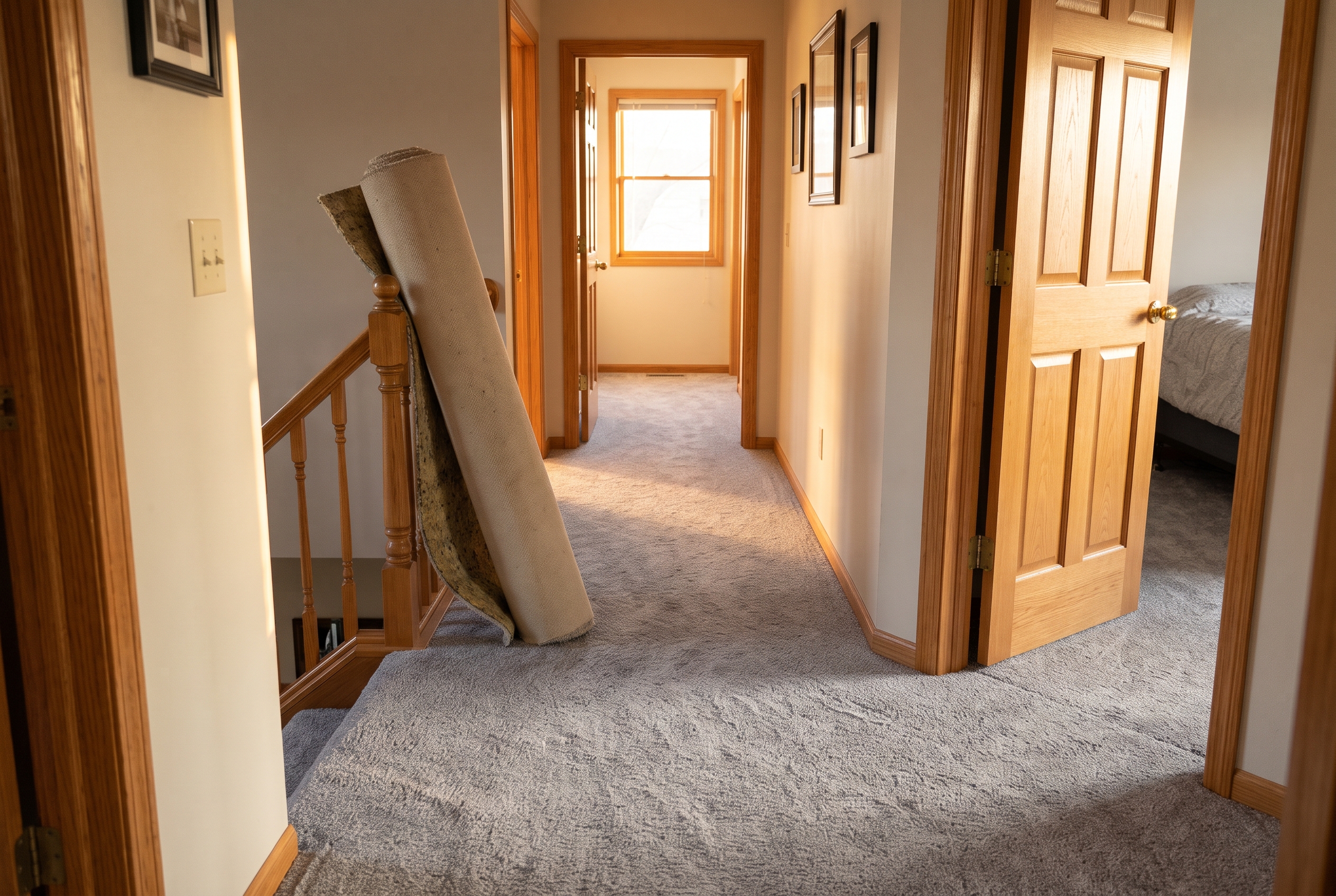
Replace carpet when the damage is in the carpet itself. That means pile that won't stand back up, spots worn to the backing, stains or odors that return after a professional cleaning, a pad you can feel, or water that soaked through. When the problem sits on the surface or in the installation, a cleaning, a repair or a re-stretch usually fixes it for far less.
Traffic lanes that stay flat after a deep cleaning mean it's time to replace. Crushed yarn has lost its twist and won't spring back.
Gray, dull carpet usually needs a cleaning first. Soil hides color, and a professional cleaning often brings it back.
Stains and odors that return after a cleaning point to replacement, along with a new pad and a sealed subfloor under any pet spots.
Ripples and buckles usually mean re-stretching, unless the backing has come apart.
A crunchy, lumpy or hard-feeling floor means a worn-out pad. New carpet and new pad go in together.
Floodwater or sewage means carpet and pad come out. Carpet wet by clean water can often be saved if it dries within a day or two.
Dated color or style is reason enough when the room no longer suits how you live or you're getting ready to sell.
| What you see | Usually means | What to do |
|---|---|---|
| Dull, gray traffic lanes | Soil in the pile | Professional cleaning |
| Lanes still flat after cleaning | Crushed, untwisted yarn | Replace |
| Ripples or buckles | Carpet came loose | Re-stretch |
| Odor back on humid days | Urine in pad or subfloor | Replace pad, seal subfloor |
| Crunchy or lumpy underfoot | Pad broken down | Replace carpet and pad |
| Backing showing through | Fiber worn away | Replace |
| Soaked by floodwater | Contamination | Remove carpet and pad |
Signs It's Time for New Carpet
Every sign that carpet needs replacing has one thing in common: the damage is in the fiber, the backing or the pad, where cleaning can't reach. Each sign comes with a simple test you can do before you decide.
Traffic Lanes That Stay Flat After Vacuuming and Cleaning
Traffic lanes that stay flat after a deep cleaning and a few slow vacuum passes against the grain have lost their twist. Each tuft of cut pile is a twisted bundle of fiber. Years of footsteps untwist and flatten it until the tips splay out and the lane looks darker than the rest of the room. Nothing makes that yarn stand back up.
A furniture dent is a different problem. It's fiber pressed flat in one spot, and it usually recovers. Set an ice cube in the dent, let it melt, then fluff the pile with your fingers or the edge of a spoon and let it dry.
Worn Spots, Fraying and Seams That Open
If you can see or feel the backing through the pile, the fiber in that spot is gone. Frayed edges at doorways, stair edges worn bald and loops pulled out of a loop-pile carpet are the same kind of damage. A separated seam can often be repaired and one small damaged spot can be patched. Wear across a room means replacement.
Stains and Faded Color That Won't Come Out
A stain that returns a few days after a professional cleaning has either set in the fiber or is rising from the pad. Bleach spots, sun fading by a window and color loss from harsh spot cleaners have taken dye out of the fiber, and no cleaning puts color back. One small spot can be patched with a leftover piece. A room full of them is a reason to replace.
An Odor That Returns After Cleaning
An odor that comes back on humid days, even after a professional cleaning, lives in the pad or the subfloor. Pet urine is the usual cause. It runs through the carpet, spreads in the pad and dries there, and humid weather brings the smell right back.
Replacing the carpet alone won't fix it. When the old carpet comes up, the pad goes with it, and the stained areas of the subfloor are cleaned and sealed with an odor-blocking primer before the new pad goes down. To find every old spot, walk the room with a blacklight after dark before install day; urine spots glow, so you can mark them.
If you still have pets, plan the next carpet around them. A moisture-barrier pad keeps the next accident in the carpet, where it can be cleaned, and a stain-resistant fiber makes the cleanup easier.
A Pad You Can Feel Underfoot
A pad that crunches when you step on it, feels lumpy, or lets you feel the hard floor in the traffic lanes has broken down. The cushion takes the impact of every step. Once it flattens, the carpet on top wears much faster, so a worn-out pad usually means the carpet is close behind.
Allergy Symptoms and Old Carpet
Old carpet doesn't cause allergies just by being old, but it can hold years of dust mite debris, dander and pollen deep in the pile and pad when cleaning has fallen behind. The Asthma and Allergy Foundation of America notes that dust mites live deep in carpet and that vacuuming alone doesn't remove them. A HEPA vacuum and a professional deep cleaning come first.
If symptoms continue after a thorough cleaning, or the carpet has ever stayed wet for days, new carpet and pad are a reasonable step. So is a hard floor in the bedroom of whoever has the allergies. Ask for carpet, cushion and adhesive with the Green Label Plus mark, the carpet industry's low-emissions label.
Water, Floods and Mold
Whether wet carpet can be saved depends on the kind of water and how fast it dries. Carpet wet by clean water, like a burst supply line, can often be saved. Pull the water out and get the carpet and subfloor dry within a day or two; the soaked pad is usually replaced. Carpet soaked by floodwater or a sewage backup comes out with its pad, because the water carries contamination that cleaning can't remove.
Texas A&M's extension service advises discarding any pad soaked by floodwater and getting water-logged carpet and pad out within 48 hours. Carpet that stays wet longer, or already shows mold, usually has to go. For a clean-water leak, our cleaning crew handles water damage cleaning, and that work needs to start right away.
Basements in Northwest Wisconsin are most at risk in the spring thaw. If a basement has taken on water before, think about whether it should get carpet again at all.
What Decides How Many Years Your Carpet Lasts
Carpet doesn't come with an expiration date. How long yours lasts depends on how it's built, the pad under it, the traffic it takes and the care it gets. That's why the same carpet can look fresh for years in a guest room and worn out in a hallway.
How carpet is built matters more than which fiber it's made of. Dense carpet, where you can't easily see or feel the backing through the pile, wears longest. In heavy traffic, a pile half an inch or shorter holds up better. Tightly twisted cut pile keeps its texture longer than loose twist, and small, tight loops outlast large, loose ones.
Three things make carpet age faster than it should: a pad too soft or thick for it, no mats at the doors, and no professional cleaning to clear out the grit that wears fibers down. Stairs, entries and hallways wear first in every house. Our look at how long bedroom carpet lasts and which fibers suit a cabin gives the typical range for bedrooms and how to get the most years out of yours.
The years on a carpet warranty describe what is covered, not how long the carpet will last. They cover wear, stains or texture under the conditions the warranty sets, and the paperwork that comes with your carpet is what counts.
Clean, Repair, Re-Stretch or Replace?
Three things decide whether to fix carpet or replace it: where the damage is, how old the carpet is, and what the fix costs compared with new. Damage on the surface or in the installation is worth fixing on carpet that still has years left. Damage in the fiber, the backing or the pad isn't.
| Problem | Try first | Replace when |
|---|---|---|
| Dull, soiled carpet | Professional cleaning | It stays dull after cleaning |
| Ripples or buckles | Re-stretching | Backing is coming apart |
| Split seam | Seam repair | Seams fail in several places |
| Small burn or stain | Patch from a leftover piece | Damage is across the room |
| Pet odor | Treat pad and subfloor | Odor is in many spots |
| Worn-through lanes | Nothing fixes it | Now |
Try a Professional Cleaning First
If your carpet looks tired but the fiber is sound, book a professional cleaning before you shop. A deep cleaning removes the soil that dulls color and mats the pile, and on carpet that has gone years without one, the difference can be dramatic. If the lanes stay flat and the stains come back, you have your answer for a fraction of the cost of new carpet. We offer professional carpet and tile cleaning as well as new carpet, so we can help whichever way it goes.
Ripples and Buckles Usually Mean Re-Stretching
Ripples and buckles show up when carpet has worked loose from the tack strip, the row of tiny angled pins that holds it along the walls. The usual causes are an installation that was not power-stretched, a pad too thick or soft for the carpet, heavy furniture dragged across it, and high humidity. The fix is to move the furniture out, pull the carpet tight in every direction with a power stretcher and hook it back on.
Re-stretching is worth it on carpet that is otherwise in good shape. Put the money toward new carpet when the backing has separated from the pile, when it has been stretched before and rippled again, or when it's near the end of its life anyway. Don't leave ripples for long, especially on stairs or in a home with older adults, because they are a trip hazard.
Replacing One Room or the Whole Floor
Replacing one room works well when a doorway or a change of flooring separates it from the rest of the house. New carpet rarely matches the carpet next to it, even in the same style and color. The old carpet has faded and worn, and the new roll comes from a different dye lot, the batch it was colored in. Open areas, connected hallways and rooms that flow together should be done at the same time, and stairs usually go with the hallway they lead to.
Should You Replace Carpet Before Selling or Renting?
Before selling, two things decide it: the carpet's condition and how soon you will list. Replace carpet that is visibly worn, stained or smells, because buyers read worn carpet as a project and odor as a problem. Carpet that is sound and only dirty usually needs a professional cleaning before the listing photos, not replacement.
Buyers notice the entry, the stairs and the main living area first. If the budget is limited, spend there and leave lightly used bedrooms for last.
Choose a neutral color, a mid-grade carpet and one style through connected rooms so the house reads as a whole. A basement that has had water often shows better with a waterproof hard floor. Give yourself a few weeks before listing to choose, schedule the install and air out the house.
For a rental, replace carpet between tenants and pick a dense, stain-resistant carpet in a medium color. If you use one style across all your units, a leftover piece from one can patch another.
Choosing the New Carpet and Pad
Choose new carpet by the traffic in each room, not by the sample that feels softest in your hand. Hallways, stairs and family rooms want dense, shorter carpet: a tight twist, a textured or patterned cut pile, or a tight level loop. Smooth plush belongs in bedrooms and formal rooms, where its footprints and vacuum marks are part of the look.
In busy rooms, medium colors, tweeds and textures hide soil far better than solid light colors, though today's stain-resistant fibers make lighter carpet practical where you want it. Take samples home and look at them in your own light, morning and evening. Start with our carpet catalog, or narrow it to textured carpet that hides footprints.
Plan on a new pad every time. Check the carpet maker's requirements for pad thickness and density, because the wrong pad causes wrinkles, buckling and seams that separate, and it can void the carpet's warranty. Busy rooms and stairs need a thinner, firmer pad than bedrooms. Our guide to carpet padding covers thickness, density and moisture-barrier pads in detail.
Some rooms are better without carpet. A basement that has taken on water, a mudroom or the room by the back door may do better with a waterproof floor. Luxury vinyl is a popular choice for lower-level family rooms.
What Moves the Price of New Carpet
The price of new carpet comes down to the carpet and pad you choose, how much of them your rooms need, and the work around them. That's why we measure your rooms and price the job at a free in-home estimate instead of quoting a square-foot price over the phone.
Carpet comes off a roll, most often 12 feet wide, so the amount you buy depends on the shape of the room and where the seams go. A room 13 feet wide needs a seam or a wider roll. Seams are placed away from doorways and traffic, which can add material. Patterned carpet adds more, because the pattern has to line up at every seam.
| What changes the price | Why |
|---|---|
| Carpet construction and fiber | Denser, heavier carpet costs more |
| Pad | Density and moisture barrier |
| Room shape and seams | Roll width sets the waste |
| Stairs | Each step is cut and fitted by hand |
| Old carpet removal | Labor and disposal |
| Furniture moving | Time on the job |
| Subfloor repairs | Squeaks, damage, odor sealing |
When you compare quotes, ask each one the same questions:
- Is the pad included, and which one?
- Is tearing out and disposing of the old carpet and pad included?
- Who moves the furniture, and is there a charge?
- Are stairs, transitions at doorways and floor prep included?
- Was the price based on a measure of my rooms?
We also offer financing for flooring projects if you would rather spread the cost out.
How Carpet Replacement Works, From Measure to Move-In
Replacing carpet happens in four stages: the measure and the choice, getting the house ready, install day, and the first weeks on the new floor. Knowing what happens at each stage is most of what you need to know before you replace carpet.
Before Install Day
To prepare for new carpet, start with two questions for whoever installs it: who moves the furniture, and who removes and disposes of the old carpet and pad. Finish any painting or wallpaper in those rooms first, since it's far easier before new carpet goes down.
- Pack up breakables, clear closet floors, and empty any dressers that will be moved.
- Unplug and unhook TVs, computers and their wiring.
- Vacuum the old carpet to cut the dust when it comes up.
- Mark old pet spots so the subfloor under them gets cleaned and sealed.
- Plan where pets and children will spend the day, and plan to open windows.
- Check whether interior doors will clear the new carpet and pad, because a thicker floor sometimes means trimming a door.
On Install Day
On install day, the old carpet and pad come up and the subfloor is cleaned. The tack strip is checked and replaced where needed, the new pad goes down, and the carpet is rolled out with the seams placed away from traffic and windows. Seams are never invisible, but sealed seam edges and good placement keep them from showing.
Then the carpet is power-stretched and hooked onto the tack strip, the edges are tucked at the baseboards, and transitions go in at the doorways. The industry's installation standard requires power-stretching because it keeps carpet from rippling later. Most carpet makers also publish detailed installation instructions, and an installation that ignores them can void the warranty. Our installation page explains how we approach the job.
The First Weeks on New Carpet
New carpet has a smell, and fresh air clears it. Open windows and run a fan during installation and for two or three days after. Most of what causes the smell is released in the first day, and it's usually gone within 72 hours. You can walk on new carpet right away.
Some shedding from new cut pile is normal. It's loose fiber left from manufacturing, and regular vacuuming clears it. If a single tuft sticks up past the rest, clip it level with scissors; never pull it.
Light and dark patches on plush carpet are shading, the way the pile reflects light when it's brushed in different directions. Shading is a trait of plush. If wrinkles appear later, have the carpet re-stretched. Keep a leftover piece of the new carpet in a closet, too; it makes later repairs easy.
The Best Time of Year to Replace Carpet Here
Carpet can be installed indoors any time of year, and winter works fine with the heat on. In Northwest Wisconsin, the muddy weeks of spring thaw make it hardest to keep a house clean during a project, and on humid summer days, open windows do less to air the house out.
If you want new carpet before the holidays or before guests arrive, plan a month or two ahead. At a cabin, install while you're there to air the place out, not right before you close it for the season.
Carpet on Stairs When You Replace
Stairs usually get new carpet at the same time as the hallway or rooms they connect to, because they wear first and old stair carpet looks worse than ever next to new. Stair carpet takes a thin, firm pad, and the pile should run toward the top of the stairs, which helps prevent slips.
Each step is cut and fitted by hand. The carpet is either wrapped tight around the front edge of each step or tucked under the nose in an upholstered style. Because stairs take more wear than any other spot, they deserve the most durable carpet in the house. If you're weighing hardwood or laminate for the stairs instead, our guide to staircase makeovers with hardwood or laminate covers safety and Wisconsin's stair code.
Replacing Carpet With Our Team
At Jensen Furniture & Flooring, we help you choose new carpet in our showroom at 101 Main Street in Luck, and our installation team puts it in. We have been family-owned since 1956. Our carpet selection includes Anderson Tuftex, DreamWeaver, Dwellings, Gulistan, Mohawk and Shaw Floors. Our in-house design staff can help you match carpet to each room and the way you live.
We come to your home for an accurate, professional measure and estimate, so the price reflects your actual rooms. We work with homeowners in Luck, Webster, Osceola, Amery, Saint Croix Falls, Grantsburg, Frederic and the surrounding area. Plan a visit to our Luck showroom to see and feel samples in person.
Carpet Replacement Questions
Can You Put New Carpet Over Old Carpet?
No. Old carpet makes a soft, uneven base that lets new carpet flex and ripple. It also keeps the old dirt and odors under your new floor, and it doesn't meet any carpet maker's pad requirements. The old carpet and pad come up, and a new pad goes down.
Can You Install Carpet Yourself?
You can, but it's rarely worth it. Wall-to-wall carpet has to be power-stretched to stay flat, seams have to be joined and sealed so they hold, and stairs take real skill to fit. Carpet laid without a power stretcher usually ripples within months.
Can Old Carpet Be Recycled?
Old carpet can sometimes be recycled, but options depend on where you live and on the carpet's fiber. Before install day, ask who will remove and dispose of the old carpet and pad, and whether recycling is available for it.
Planning Your New Carpet
If your carpet passed the test for each sign, it may only need a cleaning or a re-stretch. If it didn't, measure which rooms connect, decide whether the stairs come too, and bring your questions to our showroom. When you're ready for a measure and a firm price, schedule your free in-home estimate.


