


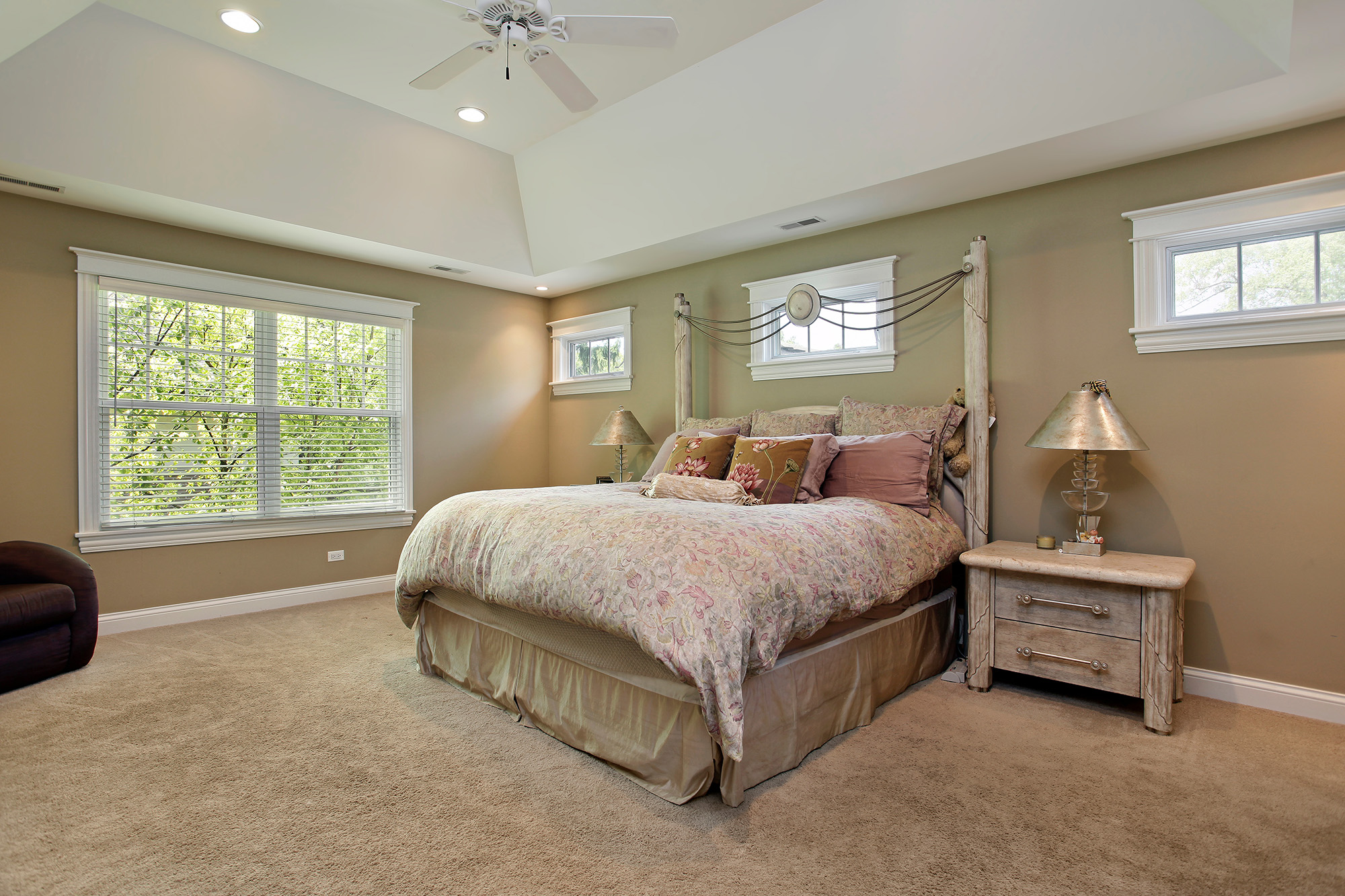
For most bedrooms in a Northwoods cabin or lake home, triexta is the best all-around carpet fiber. It feels soft under bare feet, its stain resistance comes from the fiber itself instead of an applied treatment, and it holds up to foot traffic better than ordinary polyester. Polyester is the value pick for guest rooms that see a handful of weekends a year. Nylon earns its place in bunk rooms, kids' rooms and bedrooms shared with big dogs, where the carpet has to spring back from hard use. Wool suits a year-round primary suite if the budget allows and someone is there to vacuum under the bed, and olefin belongs mainly in lower-level rooms where dampness is the bigger worry than softness.
In a cabin, though, the fiber is only part of the decision. A bedroom that sits closed up all winter, a walkout bedroom on a concrete slab and a lake-facing room that takes the afternoon sun each put carpet through things a bedroom in town never sees. Some of those conditions will decide how the carpet looks in five years more than the fiber will, so they get as much attention here as the fibers do.
How the Main Carpet Fibers Compare for Bedrooms
Most carpet made in the United States uses one of five fibers: nylon, polyester, triexta, olefin (also sold as polypropylene) and wool, with synthetics making up the vast majority. Each one balances softness, bounce-back, stain resistance and price a little differently. This is how they line up for bedroom use.
| Fiber | Feel | Bounce-back in walking paths | Stains and soil | Material price per sq. ft. | Best cabin bedroom fit |
|---|---|---|---|---|---|
| Polyester | Soft, rich color | Low; flattens where people walk | Resists water-based stains; holds oily soil | $1 to $3 | Guest rooms and other light-use bedrooms |
| Triexta | Very soft | Better than standard polyester | Stain resistance built into the fiber; holds oily soil | $3 to $8 | Primary bedrooms, kids, pets, rentals |
| Nylon | Soft to firm, depending on grade | The best of the synthetics | Relies on applied stain treatments; releases oily soil best when cleaned | $2 to $5 | Bunk rooms, big dogs, busy bedrooms |
| Wool | Soft and springy | Good; naturally resilient | Hides soil well; sensitive to bleach and harsh cleaners | $4 to $20 | Year-round primary suites |
| Olefin | Firmer; often made in loops | Low; crushes and mats | Shrugs off moisture and water-based stains; holds oily soil | $1 to $3 | Damp lower-level rooms |
The prices are national material-only ranges from HomeAdvisor's carpet cost guide, updated in June 2026; pad and installation come on top. The ranges overlap a lot, because a dense, heavy polyester can cost more than a thin nylon, so compare carpets of similar weight and density before you compare fibers on price.
Polyester: Soft, Colorful and Easy on the Budget
Polyester has a soft, luxurious feel in thick cut-pile styles, holds its color very well and resists water-based stains like juice and coffee. Its weakness is resilience. In the paths people walk every day, polyester tends to lay down and stay down, and cleaning can freshen it but cannot make the flattened pile stand back up. It also soaks up oily soil, which comes up again below.
Neither weakness shows much in a guest room that gets used a few weekends a year, so polyester is a sensible way to carpet several rooms without overspending. You can browse our polyester carpet by color and style. Save it for the rooms that stay quiet, and put your money into a tougher fiber wherever the traffic is real.
Triexta: Soft Carpet That Stands Up to Kids, Pets and Guests
Triexta is technically a type of polyester, and knowing that clears up a lot of confusion in the store. In 2009 the Federal Trade Commission created "triexta" as a subclass within the polyester category for fibers made from a polymer called PTT, so a triexta carpet's label may say either triexta or polyester. The FTC based that decision on durability: in the wear testing it reviewed, PTT carpet held its appearance under simulated foot traffic significantly better than conventional polyester. Fiber makers who weighed in also described it as softer. You'll often see it sold under brand names such as Mohawk's SmartStrand.
For a bedroom, triexta hits the balance most families want. It's very soft, it resists common household stains on its own instead of depending on a surface treatment, and it holds its color in sunlight. It shares one trait with polyester and olefin: it absorbs oily soil readily, and a triexta carpet that goes years without a proper deep cleaning can reach a point where no cleaning fully restores it. In a bedroom, staying ahead of that is easy. Our triexta carpet selection is a good place to start for a primary bedroom, a kids' room or a room the dog sleeps in.
Nylon: The Fiber That Bounces Back
Nylon is the most resilient synthetic carpet fiber. It's durable, resists abrasion, handles wet cleaning well and springs back after heavy traffic, and the heat of a professional hot-water cleaning helps a matted nylon pile stand back up. It also gives up oily soil more easily than polyester or triexta when it's cleaned. Most residential nylon gets its stain resistance from treatments applied after the carpet is made, and harsh, high-alkaline cleaners can weaken those treatments and affect the warranty, so stick to cleaners the manufacturer approves.
In a quiet bedroom, that toughness is more than the room needs. Nylon makes sense where a bedroom behaves like a family room: a bunk room where the grandkids wrestle, a bedroom at the top of the stairs that everyone cuts through, or a room shared with a big dog that runs in from the lake.
Wool: Natural Luxury, With Cabin Caveats
Wool is the only natural fiber of the five, and it has real strengths. It's naturally resilient and durable, and the scaly surface of each fiber scatters light, which helps hide soil. It's also largely self-extinguishing, charring instead of melting when it meets a flame, which some owners appreciate in a bedroom with a wood stove or fireplace. (Carpet sold in the U.S. has to pass a federal flammability test, so synthetic carpet is not unsafe; wool simply handles a stray ember more gracefully.) Wool makes up less than 1% of the carpet fiber used today, and its price shows it.
A seasonal cabin is a harder place for wool, though. Clothes moth larvae feed on wool carpets and rugs, and carpet beetle larvae eat wool too, while carpet made entirely of synthetic fiber is left alone. Damage tends to start in dark, undisturbed spots such as carpeted areas under furniture, and soiled fibers draw more of it. A cabin bedroom that sits closed for months, with the bed and dresser never moved, is that kind of spot. Moisture is the other concern: wool is very absorbent, so it dries more slowly than synthetic carpet after a wet cleaning, which matters in a humid lake home. Wool also dissolves in chlorine bleach and can be damaged by harsh, high-alkaline cleaners, so it needs the right cleaning products. It's a lovely carpet for a home someone lives in and vacuums year-round, including under the furniture.
Olefin: Moisture-Tolerant but Quick to Crush
Olefin resists moisture, fading and stains, generates little static, and is one of the least expensive fibers. Olefin yarns are almost always solution-dyed, meaning the color goes into the fiber as it's made, so sunlight has little effect on it. On the other hand, it is less resilient than nylon, so it crushes and mats under traffic, it holds oily soil, and dragging heavy furniture across it can leave friction-burned streaks.
In a bedroom, where softness is usually the whole point, olefin is the least cushy option. Its natural fit is a lower-level room where moisture is the main concern, but its moisture resistance does not make carpet safe on a damp slab, as the section on walkout bedrooms below explains.
Which Carpet Fiber Fits Which Bedroom
Bedrooms in a cabin or lake home don't all live the same way. A primary bedroom in a year-round lake house works nothing like a bunk room that fills up every Fourth of July, so match the fiber and style to how each room is used.
| Bedroom | Fiber to start with | Style that works | Watch for |
|---|---|---|---|
| Primary bedroom, lived in year-round | Triexta or polyester; wool if the budget allows | Plush or saxony cut pile over a softer pad | Plush shows footprints; textured hides them |
| Guest room used a few weekends a year | Polyester | Cut pile or textured | Fading if it faces the lake; months closed up |
| Kids' or grandkids' bunk room | Nylon or triexta | Textured or cut-loop pattern in a mid-tone | Sand, snacks and play; more traffic than most bedrooms |
| Bedroom shared with dogs or cats | Triexta or nylon | Cut pile; skip loops | Claws snag loops; accidents |
| Walkout or lower-level bedroom on concrete | Olefin or polyester, only if the slab stays dry | Lower pile over a moisture-barrier pad | Condensation under the carpet |
| Short-term rental bedrooms | Triexta or a solution-dyed fiber | Textured or patterned, flecked mid-tone | Guest spills, sunscreen, cleaning between stays |
In any room a pet sleeps in, keep the claws in mind. A loop carpet can catch a dog's or cat's claw and pull a strand, so cut-pile styles are the safer bet, and a fiber with built-in stain resistance takes the stress out of the occasional accident. Our look at whether carpet and pets are a good idea covers the rest of that question.
What Lake and Cabin Living Does to Bedroom Carpet
A lake home runs on bare feet in July, and many cabins sit on a low thermostat in January. Both seasons leave their mark on a carpet, and the right fiber takes care of only part of it.
Sand, Bare Feet and Sunscreen
Synthetic carpet in a bedroom almost never wears through. With synthetic fibers it is nearly impossible to wear out the face yarn; what fails is appearance, when a carpet without enough density crushes, mats and dulls in the paths people walk. So the goal in a lake-home bedroom is to keep the carpet looking good, and summer works against that.
Sand and grit are the obvious problem. They settle deep in the pile and dull the fibers as people walk over them, so vacuum more often in summer, slowly and in more than one direction, and keep a mat and a shoes-off habit at the door that comes up from the beach. The less obvious one is oil. Skin oils, sunscreen and bug spray all ride in on bare feet, and polyester, triexta and olefin all soak up oily soil. Cleaned regularly, that's no problem. Left for years, it builds up until the walking paths look permanently dingy. Nylon releases oily soil more easily, which is one more reason to choose it for a bunk room that sees wet, sandy, sunscreened feet all summer.
Afternoon Sun Through Lake-Facing Windows
Lake homes are built around the view, and big west- or south-facing windows can fade a bedroom carpet unevenly over the years. The fiber's dyeing method matters most here. Solution-dyed fibers have their color added while the fiber is being made, so it runs all the way through each strand and resists fading very well. Olefin is almost always solution-dyed, triexta holds its color well in sunlight, and solution-dyed nylon is available too. For a bedroom with a wall of glass, ask whether a carpet is solution-dyed before you fall for its color.
Shades that filter sunlight protect carpet along with the furniture, and window coverings are something we can help with as Northwest Wisconsin's only Hunter Douglas Gallery dealer. And if the room is wide enough to need a seam, the carpet installation standard calls for placing seams so natural light does not strike across them, because low sun raking over a seam makes it easy to see, so talk through where any seam will fall before the carpet is cut.
Humid Summers, Closed-Up Cabins and Mildew
Mold and mildew need both moisture and dirt to grow, and a closed-up cabin in a humid July can supply both. EPA advises keeping indoor humidity below 60%, ideally between 30% and 50%, and drying anything that gets wet within 24 to 48 hours; after that, mold is likely, and moldy carpet may have to be thrown out because it can't be fully cleaned. An inexpensive humidity meter will tell you where a cabin stands.
No fiber makes carpet mildew-proof, because mildew grows on the soil in a carpet and in a pad that stays wet, whatever the yarn is made of. What protects a cabin bedroom is keeping the carpet clean, running air conditioning or a dehumidifier through muggy stretches, and keeping wet towels, swimsuits and life jackets off the floor.
Walkout and Lower-Level Bedrooms on Concrete
Many lake homes have walkout lower levels, and bedrooms down there need extra thought before carpet goes in. EPA points to two problems with carpet on a concrete slab. Moisture can rise through the slab and keep the carpet damp. And a slab without insulation underneath is often colder than the room air; carpet insulates the top of the slab and keeps it colder still, so moisture in the room's air can condense on the concrete under the carpet, where nobody sees it until it smells.
That's why a "moisture-resistant" fiber doesn't settle the question. Olefin won't absorb water, but the pad and backing beneath it can stay wet all the same. If the slab stays dry and the room stays conditioned, a lower-pile olefin or polyester over a moisture-barrier pad can work; our guide to what carpet padding does explains how those barrier pads keep spills and moisture out of the cushion. If the slab sweats, has flooded before or smells musty, EPA's suggestions are a vapor barrier with an insulated subfloor, or hard flooring with area rugs you can take up and wash. Our article on luxury vinyl in lower-level rooms covers that route.
Cabins Kept Cold All Winter
The carpet industry's residential installation standard says rooms with carpet should never be allowed to drop below 50°F, no matter how long ago the carpet went in, and that if that can't be done, the owner should check with the carpet manufacturer about the warranty. The standard warns that colder conditions can lead to moisture problems, including condensation. With January lows in Luck averaging under 5°F, an unheated cabin falls far below 50°F. If you drain the plumbing and shut the heat off, or turn the thermostat down to 45°F for the winter, read the carpet's warranty before you buy.
The same standard shapes when the carpet can go in. Installation should happen with the heat running and the room between 65°F and 95°F at no more than 65% humidity, held for 48 hours before, during and 72 hours after, with the carpet itself sitting in those conditions for at least 24 hours beforehand. For a seasonal place, that means warming the cabin a couple of days ahead of the job and leaving the heat on for a few days afterward. Our flooring installation page explains how we approach the work itself.
Dry Winter Air and Static Shocks
Luck averages about 32 nights a year below zero. On those nights, keeping indoor humidity low enough to avoid frost and condensation on the windows means holding it around 25% when it's 0°F outside and closer to 20% at 10 below. Static builds up in dry air, and the industry tests carpet for static at 20% relative humidity, so on a cold January night a Luck bedroom is about as dry as the chamber carpet is tested in.
If winter shocks bother you, ask whether the carpet you're considering has permanent, built-in static control. Olefin generates little static on its own. A humidifier helps, but keep it within those window limits so you're not trading shocks for wet sills.
Softness, Warmth and How the Carpet Is Built
Fiber decides a lot, but two carpets of the same fiber can feel and age completely differently depending on how they're made.
Pile Styles That Work in Bedrooms
The Carpet and Rug Institute sorts residential styles by how the yarn is finished, and each suits a different bedroom:
- Plush (velvet): dense and luxurious, best in low-traffic rooms, and quick to show footprints and vacuum marks. The classic primary-bedroom carpet.
- Saxony: a refined, smooth cut pile with a more formal look.
- Textured plush and frieze: twisted yarns that hide footprints and vacuum marks, with a more casual look that suits a cabin.
- Loop and Berber: uniform loops that hold up to traffic; flecked Berbers hide dirt well, but loops are the wrong pick where pets sleep.
- Cut-loop: cut and looped yarns combined into sculpted patterns, often multicolored, which hide soil and stains well in a kids' room or rental.
To compare them, you can browse soft cut-pile carpet, textured styles that hide footprints and patterned carpet with more visual texture in our catalog.
Density and Twist: The Specs That Predict How It Ages
Density is how tightly the yarn is packed. Higher density generally means better performance, and a carpet with too little density crushes no matter what fiber it's made of. Twist is how tightly each yarn is wound, and a tightly twisted cut pile holds its shape longer. When you've settled on a fiber, compare density and twist between carpets of that fiber; they explain why two similar-looking carpets at different prices age so differently.
Which Carpet Is Warmest?
Thickness, not fiber, is what makes a carpet warm. A study by Georgia Tech's textile engineering school found that a carpet's insulating value depends far more on its total thickness than on its fiber, and estimated that value at about 2.6 times the thickness in inches. In that testing, a wool plush and a nylon saxony with about half an inch of pile each rated close to R-2 (R-2.19 for the wool, R-1.96 for the nylon). Insulating values also add up: a carpet rated R-1.3 over a prime foam cushion rated R-1.6 totals R-2.9.
So for the warmest bedroom, choose a thicker pile over a good cushion, and pick the fiber for its other qualities. Our article on whether carpet can warm a room goes further into how that helps on a cold morning.
Carpet Over In-Floor Heat
Some lake homes have in-floor radiant heat, often in the lower level. Carpet works over it, but the insulation that makes carpet feel warm also slows the heat coming up from the floor. Most radiant system makers suggest keeping the combined R-value of carpet and cushion at 4.0 or less, and a lower pile over a thinner cushion lets more heat through. It's also wise to confirm with the carpet maker that the backing is suited to long periods of low, steady heat.
The Pad Under a Bedroom Carpet
Bedrooms are one of the few places where a thicker, softer cushion is a good idea. The Carpet and Rug Institute notes that bedrooms and other light-traffic rooms can use thicker and softer cushion, while hallways, stairs and family rooms need thinner, firmer pad. Stay within the thickness and density your carpet's maker calls for, because the wrong cushion can cause wrinkling and seam problems and may void the warranty. Our guide to choosing carpet padding for comfort or durability weighs that trade-off.
Is Carpet a Good Idea in a Bedroom if You Have Allergies?
It depends on how sensitive the person is. The Asthma and Allergy Foundation of America recommends bare floors in the bedroom, since people spend a third of their time there, and suggests low-pile carpet or washable rugs if you do want something soft, along with vacuuming once or twice a week with a vacuum certified to keep allergens from blowing back into the air. The carpet industry makes the other side of the case: carpet holds dust until it's vacuumed away, instead of letting it drift around the room.
Both points lead to the same practical answer. For someone with a serious dust-mite allergy, a hard floor with a washable rug is the safer bedroom. For everyone else, a low- to medium-pile carpet and a good vacuum with a high-filtration bag, used often, keep allergens down.
What Bedroom Carpet Costs
Nationally, installed carpet runs about $3 to $11 per square foot, according to HomeAdvisor's June 2026 figures, and carpet is often priced by the square yard, at $30 to $50 a yard. The same guide puts three average bedrooms, about 500 square feet in all, at $1,500 to $5,500. Fiber sets much of that spread (see the table at the top), and the rest comes from:
- Pad: about $0.75 to $2 per square foot installed.
- Removing old carpet: about $1 to $5 per square foot.
- Density and weight: a denser, heavier carpet uses more yarn and costs more within any fiber.
- Closets, stairs and odd shapes: extra cutting and labor.
- Room width versus roll width: often the biggest hidden cost in a bedroom.
Roll width matters because carpet is made in only a few fixed widths. In the U.S., almost all carpet comes in rolls 12 feet, 13 feet 6 inches or 15 feet wide, and 12 feet is by far the most common. A 12-by-14-foot bedroom fits a 12-foot roll with almost nothing wasted. Make that room 13 by 14 and you either cut it from a wider roll and pay for the leftover strip (a 15-foot roll means buying about 15% more carpet than the floor needs) or add a seam. If the style you like comes in 13 feet 6 inches, the waste nearly disappears, so ask which widths a carpet is made in before you settle on it. If you'd like to spread the cost of a whole-cabin project, we offer flooring financing.
How Long Bedroom Carpet Lasts and How to Keep It Looking New
Most carpet lasts 5 to 20 years, and bedrooms sit toward the long end, because higher-quality fibers and light traffic push carpet closer to 20 years while heavy traffic, kids and pets shorten it. What decides where yours lands is mostly care:
- Vacuum regularly with a vacuum that has strong airflow and a high-filtration bag, and more often in summer when sand comes in.
- Blot spills right away, and use cleaners your carpet's maker approves.
- Have the carpet deep cleaned by hot-water extraction before it starts to look dirty. Shaw, for example, recommends professional cleaning every 12 to 18 months and at least every 24; check what your own carpet's warranty asks for.
A good time for that deep cleaning at a lake home is the end of the summer season, when a few months of sand and sunscreen have built up. Jensen's professional carpet cleaning service, formerly Interstate Cleaning and serving the area since 1987, can take care of it.
A Carpet Checklist for Closing and Opening the Cabin
- Vacuum every carpeted bedroom thoroughly before you leave, including under the beds and dressers and along the edges, where moths and carpet beetles start.
- Get wet towels, swimsuits and life jackets off the floor and out of the bedrooms.
- Keep carpeted rooms at 50°F or warmer, or check your carpet warranty if the cabin will be colder.
- Keep summer humidity below 60% with air conditioning or a dehumidifier if the cabin sits closed in muggy weather.
- When you open up, air the rooms out and check lower-level bedrooms for musty smells or damp spots. Dry anything wet within 24 to 48 hours.
- Book a professional deep cleaning at the end of each summer season.
When Carpet Isn't the Best Choice for a Cabin Bedroom
Carpet is hard to beat for a warm, quiet bedroom, but a few rooms are better off with a hard floor and a rug: a walkout bedroom on a slab that sweats or has flooded, a bunk room that doubles as the path from the beach, where wet swimsuits hit the floor every afternoon, and a bedroom for someone with serious dust-mite allergies. A waterproof luxury vinyl or a wood floor with an area rug you can take outside and shake keeps most of the comfort without the risk. Our ideas for pairing cabin floors with rugs and furniture show how that can still feel cozy.
Cabin Bedroom Carpet Questions
Is triexta better than nylon for a bedroom?
For most bedrooms, yes. Bedroom traffic is light, so nylon's main advantage, its bounce-back under heavy use, matters less there, while triexta's softness and built-in stain resistance matter every day. Nylon is the better pick for a bedroom that takes family-room abuse, such as a bunk room or a room with a big dog, and it releases oily soil more easily when it's cleaned.
How soon can someone sleep in a newly carpeted bedroom?
With good ventilation, the mild smell of new carpet usually fades within 48 to 72 hours. The Carpet and Rug Institute suggests opening windows and running fans during installation and for about 48 hours afterward, so at a cabin it helps to have carpet installed early in a stay and let the rooms air out before guests use them. If you're sensitive to odors, ask for carpet, cushion and adhesive certified under CRI's Green Label Plus program, which tests for the lowest emissions.
What carpet color hides sand and pet hair best?
A mid-tone with some variation in it hides the most. Flecked Berbers and multicolored cut-loop patterns are especially good at hiding soil, and a tone close to your beach sand or your dog's coat makes both disappear between vacuumings. Very light carpet shows every grain, and very dark carpet shows lint, light-colored pet hair and dried sand.
Will new carpet fix a musty-smelling cabin bedroom?
Not on its own. A musty smell means moisture, and new carpet over the same damp slab or under the same humid air will end up smelling the same way. Find and fix the source first: run a humidity meter, check the lower level for sweating concrete or past water, and remove any carpet or pad that has already grown mold, since EPA notes moldy carpet may have to be thrown out. Then choose the floor.
Seeing Carpet in Your Own Cabin Light
Carpet looks different under showroom lights than it does in a pine-paneled bedroom with the lake light coming in, so order samples through our carpet catalog and look at them in the room, morning and evening, before you decide. When you know which bedrooms you're doing and which fibers are on your list, request a free flooring estimate and we'll measure the rooms and price the carpet and pad for how each one is used.


