


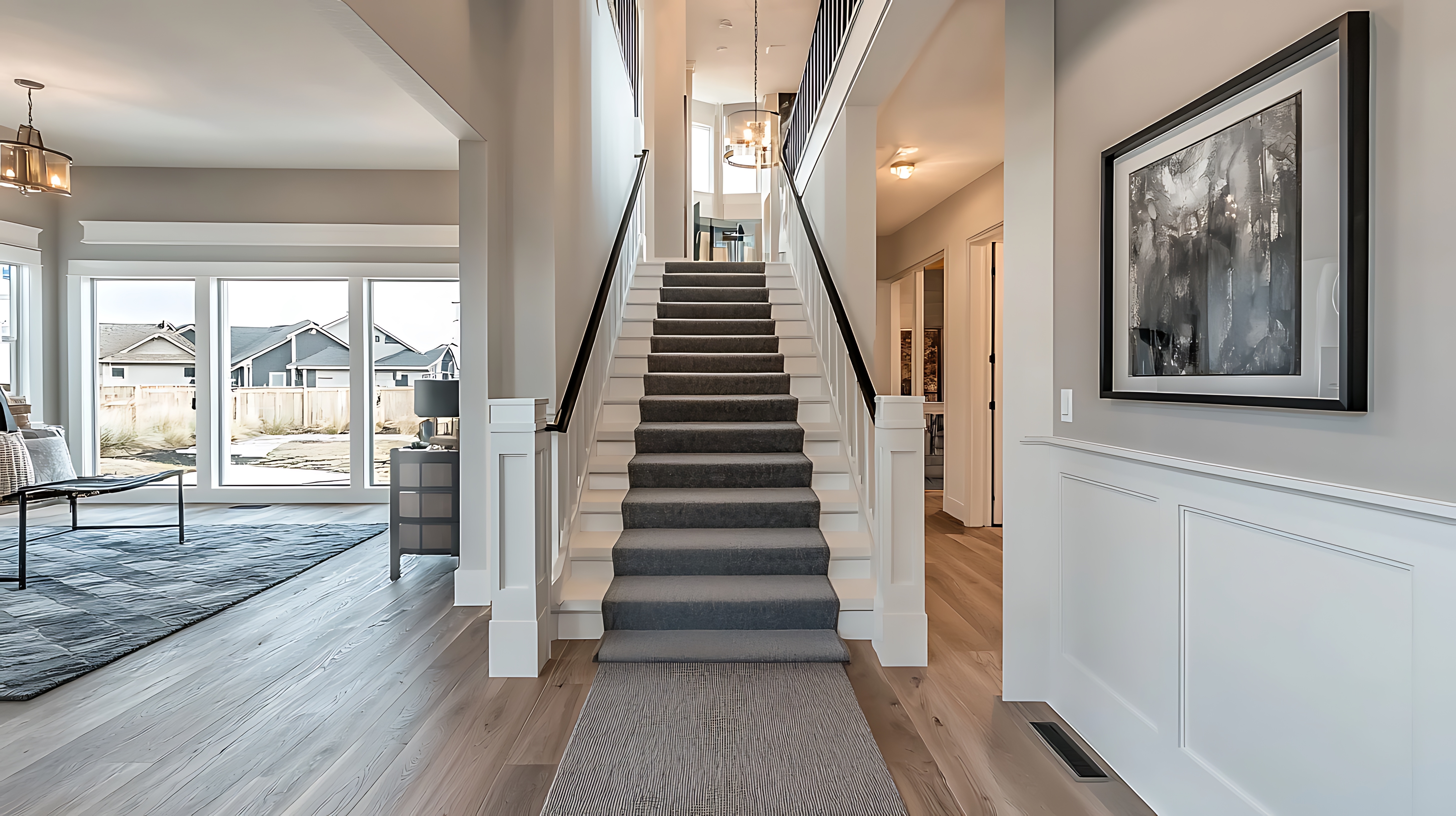
Stairs are the most dangerous stretch of floor in the average home. When researchers at the Center for Injury Research and Policy at Nationwide Children's Hospital reviewed 23 years of national emergency-room data in the American Journal of Emergency Medicine, they counted nearly 25 million stair-related injuries, more than a million people a year. That is why safety belongs in a staircase makeover from the start, before anyone picks a color. The reassuring part is that most of what makes a stair safe is in your hands, riding on choices you're about to make anyway.
Here's the good news for Wisconsin homeowners. Hardwood and laminate can both make a staircase safer, and neither one is safer than the other by default. What makes a stair safe is how the floor is finished and installed, not the name on the box. The real choice comes down to your budget, your moisture, and how hard the stairs get used. This guide walks through all of it: why stairs hurt so many people, what the research says actually prevents it, what Wisconsin's code calls for, and how the two materials compare step by step.
Hardwood or Laminate for Stairs: The Short Answer
Hardwood and laminate both work on stairs, and either one can be made equally safe. The right pick depends on budget, moisture, and traffic more than on the material itself. Here's the quick version before the detail.
A safe stair does three things: you can see each edge, your foot grips, and every step is the same size.
Most falls happen going down. The front edge of the step is what your eye needs to catch.
Hardwood lasts longest and refinishes for decades. Laminate costs less and shrugs off scratches.
On stairs, the flooring has to be glued and fastened, never floated, and finished with a matching stair nose.
Skip the high-gloss. A matte surface with a little texture grips far better and hides scuffs.
How Dangerous Are Stairs, Really?
Stairs send more than a million Americans to the emergency room every year, which puts them among the top causes of injury in the home. That count comes from the Nationwide Children's Hospital team's review of national injury data in the American Journal of Emergency Medicine, and the trend is going the wrong way: the same analysis found stair injuries climbed 24% between 1996 and 2012. When a fall lands someone in the hospital, the damage usually hits the lower body or the head. Here's how the injuries break down in that national data.
Stair injury (U.S. ER data, 1990–2012) | Share of visits |
|---|---|
Sprains and strains | 32.2% |
Soft-tissue injuries | 23.8% |
Fractures | 19.4% |
Injuries to the legs, ankles, and feet | 42.1% |
Injuries to the head and neck | 21.6% |
Two groups get hurt far more than the rest: the very young and the old. The same research group, publishing in the journal Pediatrics, found that more than 93,000 children under five were treated for stair injuries in a single decade. Nearly 75% of them hurt the head or neck, and the injuries were worst for babies being carried down the stairs, which made a hospital stay more than three times as likely. There's a hopeful thread in that same Pediatrics study: better awareness and safety gates helped cut those childhood injuries by about 12% over the ten years. Stairs can be made safer, and the data proves it.
Older adults carry the highest stakes. The Centers for Disease Control and Prevention reports that falls are the leading cause of injury death for people 65 and older. More than 1 in 4 older adults falls each year. In 2024, falls killed 43,020 of them and sent about 3.85 million to the emergency room. A staircase is where a stumble turns into a hospital stay, and it's one of the few spots in a home you can redesign to change the odds.
Wisconsin has a sharper stake in this than most states. The CDC ranks it the deadliest state in the nation for older-adult falls, with more than 1,800 Wisconsinites 65 and older dying from a fall in 2024. The Wisconsin Department of Health Services reports that fall-related calls have become so common they now account for about 21% of every EMS ambulance run in the state. Not all of those falls happen on stairs. But in a state where falls are this lethal, the staircase is the one fall hazard you can rebuild, and a safer set of steps is a real intervention rather than a decorating upgrade.
Why Do People Fall on Stairs?
Your body learns a staircase in the first step or two, then runs the rest on autopilot. That autopilot is why stairs feel effortless almost all the time. It's also why they turn dangerous in a blink. When something breaks the pattern your body expected, the miss happens before you can think it through. The definitive study of the subject, architecture professor John Templer's two-volume The Staircase from MIT Press, drew on two decades of human-factors research to catalog exactly how that pattern breaks. Three causes come up again and again, and each one maps onto something you can fix in a makeover.
The first is direction. Going down is far riskier than going up. An analysis of workplace stair accidents in the Journal of Safety Research found that 92% of the falls happened while the person was descending. The usual culprit is overstepping, where the foot reaches past the front of the tread and lands half on the edge, half on air. Descent is hard for a plain reason: you're fighting gravity and momentum at once, and you have to find each edge with your eyes before you trust your weight to it. Miss it and there's no second chance to correct.
The second is a step you can't see clearly. That same descent problem is partly an eyesight problem, because a step down is harder for the eye to read than a step up. A step up throws shape and shadow toward you; a step down hides its edge below the lip of the tread. On the way down, that front edge is the one detail your eye has to catch on every step, in whatever light the stairwell happens to have. When the tread and the riser below it are close in color, the edge vanishes and your foot guesses.
The third cause is the one nobody thinks about, and it may be the most dangerous. It's a step that doesn't match the others. Biomechanics researchers at Liverpool John Moores University, writing in the journal Applied Ergonomics, studied 80 real stair falls and found that 60% happened on stairs whose step height varied by more than about 9.5 millimeters, just over 3/8 of an inch. Your autopilot expects every step to be identical. One step off by half an inch is enough to catch a toe on the way up or drop you short on the way down. Traction, visibility, and even steps: those are the three levers a safer staircase pulls.
What a Safe Staircase Needs
A safe staircase gets three things right. You can see the edge of every step. Your foot grips the tread. And every step is the same height as the one before it. That last one hides behind the word "consistency," so here it is in plain language: the risers are all the same, your leg lifts the same amount each time, and nothing surprises it. A flooring choice sets the first two directly, through the finish and the fit. The third is mostly about the install.
Two more features back up the three, and both have hard research behind them. A handrail gives you something to grab when you slip. Biomechanics researchers led by Brian Maki, writing in the journal Safety Science, showed that a graspable rail lets a person arrest a fall that's already in motion. A rail on both sides helps most, since a hand shoots out by reflex toward whichever side is closest. Lighting is the other one, and the effect is measurable. A 2021 study in the American Journal of Ophthalmology found that among people with weaker eyesight, brighter stairs meant far fewer falls, with roughly half the fall rate once lighting reached about 30 footcandles, the level of a well-lit kitchen. A grippy floor in a dim stairwell with no rail is still a dangerous stair.
Wisconsin's Stair Code, in Plain English
Your stairs were almost certainly built to the Wisconsin Uniform Dwelling Code, the state's rulebook for one- and two-family homes. The numbers below are what the code calls for, and what each one buys you. The one that matters most is the evenness rule. Wisconsin allows no more than 3/8 of an inch of difference between the tallest and the shortest step in a flight. That's almost exactly the threshold the Liverpool John Moores researchers tied to real falls. The code isn't being fussy here. It's drawing the line right where a stair stops being predictable to your body.
Wisconsin code (SPS 321.04) | The rule | Why it matters |
|---|---|---|
Step-to-step variation | 3/8 inch maximum | Every step feels the same to your foot |
Tread depth | At least 9 inches | Room for the ball of your foot to land without overhang |
Riser height | 8 inches maximum | No step demands too big a lift |
Stair width | At least 36 inches | Room to pass and to carry |
Headroom | At least 76 inches | Tall adults aren't ducking |
Handrail | Required over 3 steps, 30 to 38 inches high | Something to grab, at the right height |
Handrail and guard strength | Holds a 200-pound push, any direction | It won't give way when you lean on it |
Open risers | No gap a 4-inch ball fits through | A small child can't slip between steps |
The minimum tread depth of 9 inches is worth a second look, because it ties straight back to overstepping. On the way down, the ball of your foot needs enough tread to land on without hanging over the edge. Shallow treads are where oversteps happen, so the code's minimum is really a floor for the size of your foot. A makeover rarely touches the framing, but it can still break these numbers. The usual mistake is laying thick new treads over an old staircase and lifting the height of only the top or bottom step. That creates the exact odd step the evenness rule exists to prevent. When we look at a staircase, these are the measurements we check before we ever talk about color.
Wisconsin adds a few wrinkles the code can't cover. Many homes here have a basement or a walkout lower level, so one flight often lands on concrete, where moisture becomes the deciding factor. Entry and mudroom stairs meet road salt, snowmelt, and grit all winter, and that film turns a decent floor slick. Lake cabins and cottages sit empty and unheated for stretches, so the humidity swings hard between seasons. None of that changes the code. All of it changes which floor and finish will actually hold up on your steps.
Traction: How Much Grip Does a Stair Need?
Grip comes from the finish and the texture, more than from the type of wood, and you can have plenty of it without a rough or dull floor. There's a lab measure for it, called DCOF, or dynamic coefficient of friction, which scores how hard a surface resists sliding. The Tile Council of North America's ANSI A326.3 standard treats 0.42 as the mark for a floor that might get walked on wet. It's a useful reference point, but it doesn't settle the question on a stair.
Two things keep that number from being the whole answer. Wood and laminate makers rarely publish a DCOF figure at all, and the 0.42 mark was written for flat floors, while a staircase is steeper and works with gravity against you. So you stack the odds instead of chasing one number. Choose a matte or satin sheen over high gloss. A glossy stair looks gorgeous in photos and behaves like glass under a wet sock. That single choice does more for footing than almost anything else.
Texture is the next layer. On hardwood, a wire-brushed or hand-scraped surface raises the grain a little, so it grips better and hides the fine scratches that boots and dog nails leave behind. On laminate, the better lines press a matching texture into the surface, so the step feels like wood instead of a slick photo of it. Then there's upkeep, which matters as much as the finish. Grit, sand, and road salt roll underfoot like tiny ball bearings, and a Wisconsin winter tracks all three onto the steps. Keeping the stairs swept is the plainest safety advice we can give, and it costs nothing.
Visibility: Can You See Every Edge?
Seeing the front edge of each step is a safety feature, and the research is strong enough to drive your color choices. Because most falls happen on the way down, the edge of each tread has to stand out against the riser below it. Designers measure this with Light Reflectance Value, or LRV, a 0-to-100 scale of how much light a surface bounces back. Britain's accessibility building standard, Approved Document M, puts a harder number on it than U.S. rules do: it calls for at least a 30-point LRV gap between a step edge and the surface behind it. In plain terms, put clear light-against-dark contrast at the nose of every step.
The payoff is bigger than it sounds. A 2025 observational study in the Interactive Journal of Medical Research watched people on two stairways that both had uneven steps, one plain and one fitted with high-contrast striping on the edges. Of the fall-related events the researchers recorded, 81% happened on the plain stairway and only 19% on the striped one. That's a large drop from one simple change, and it's the reason edge contrast deserves a real place in your plan.
You've got a few ways to build that contrast in. Dark-stained treads over light or white risers do it, and they bounce light into a dim stairwell as a bonus. A single wood tone works too, paired with a contrasting strip or a nose in a lighter or darker shade. It matters most for the people carrying a laundry basket that hides their own feet, for kids barreling down in the morning, and for aging eyes. Then light the stairs well, with a switch at the top and the bottom. Even perfect contrast disappears in the dark.
The Stair Nose: The Detail That Makes or Breaks the Job
The stair nose is the rounded or squared piece that finishes the front edge of each step. It's the part your foot meets first on the way down, and it takes the most wear of anything on the staircase. Do-it-yourself jobs and rushed installs fail here more than anywhere else. The mistake is almost always about how the floor is attached underneath.
In a bedroom, laminate floats. The planks lock together and rest loose over a pad so they can expand and contract with the seasons. A staircase can't work that way. Laminate on stairs has to be glued down and usually screwed or nailed as well, so nothing shifts when you step on the edge. A floating, unglued stair is a real hazard, and it's one of the most common first-timer mistakes we're called in to fix.
How the floor is attached also picks the nose. A flush nose sits level with the flooring for a clean, built-in look, and it suits a glued-down stair. An overlap nose laps over the edge to leave room for a floating floor to move, so it belongs in a hallway rather than on steps. Buy the matching nose from the same product line as your flooring, in the same color and finish. Piece one together later and it clashes with the tread and wears at a different rate. On hardwood, that front edge can also be gently rounded, or eased, to soften the corner while keeping the step clearly defined.
Hardwood on Stairs: Built to Refinish
Hardwood gives you a firm, quiet staircase you can refinish for decades instead of replacing. Real wood makes a split-level or a two-story feel more open, and a solid tread feels predictable the moment your foot lands. There's one thing to understand about it: wood moves with humidity. It swells when the air is damp and shrinks when it's dry. The National Wood Flooring Association, which writes the U.S. installation standards for wood floors, recommends keeping a home between 35% and 55% relative humidity, at 60 to 80 degrees. That's the band where wood stays put.
Wisconsin makes that band hard to hold. A long heating season drives indoor air below it, and summer pushes it back up the other way. A winter humidifier keeps a wood staircase from gapping and cupping, the movement behind the creaks and the uneven steps you feel on old wood stairs. Where your stairs sit decides which wood belongs there. Solid hardwood is milled from one piece and sands back to new many times over its life. Because it moves so much, the standards keep it out of below-grade spaces, and most warranties won't cover it in a basement.
Engineered hardwood answers that problem. It layers a real-wood top over a plywood-style core, built with the grain of each layer crossing the next, which holds the plank flat through humidity swings. Engineered wood can go on any level, basement stairs included. The finish matters as much as the wood underneath. Factory-finished floors arrive coated in aluminum oxide, which rates about 9 on the 10-point Mohs hardness scale and is one of the toughest surfaces made for wood. It's cured rock-hard under UV light before it reaches your house, with no odor and no long dry time, unlike a finish brushed on site. On a staircase, we steer most families toward a matte, wire-brushed finish, because it grips, it reads well in a dim stairwell, and it hides the scuffs a busy stair collects. When you're ready to compare species and grades, start with the hardwood Jensen carries, much of which comes with matching stair parts.
Laminate on Stairs: Tough for the Price
Laminate gives you a tough, budget-friendly staircase that shrugs off boots, claws, and grit. It's a favorite for cabins, rentals, and busy family homes. A laminate plank is a dense fiberboard core under a printed wood-look layer and a clear wear layer on top. That wear layer takes the beating on a stair, and its toughness is graded on the AC scale, short for Abrasion Class, which our guide to AC ratings and plank thickness breaks down in full. The scale is defined by the European standard EN 13329 and certified for the North American market by the North American Laminate Flooring Association. A machine spins a grit wheel on the surface and counts how long the top layer lasts before it wears through.
The grades run AC3 for ordinary homes, AC4 for heavy home and light commercial use, and AC5 for stores. On a stair, your foot pivots and drives its weight onto a small patch, so AC4 is the sensible floor. You can browse laminate rated AC4 to see which styles qualify. Rating aside, look for a textured, low-sheen surface, since that's what gives you grip on the way down.
Two more things are worth knowing before laminate goes on steps. Its rigid core can sound hollow underfoot, so a good installer adds an acoustic pad on the landings, where padding is allowed, to quiet the footfall. And a stair that meets snow, slush, and sand does better in a water-resistant line built for it. If your entry or lake-cabin steps take a beating each winter, the laminate built for Northwest Wisconsin winters is worth a look. Because laminate costs less than solid wood, it frees up budget for the lighting and handrail that the research says matter just as much as the floor.
What About Carpet Runners or Vinyl on Stairs?
Hardwood and laminate are the two most popular hard-surface picks for stairs, but they aren't the only options, and the safest stair sometimes mixes them. A carpet runner down the center of a wood staircase adds real traction and softens a fall if one happens. That's why it's a common choice in homes with older adults or dogs, and it quiets the stairs on top of it. The trade-off is upkeep. A runner traps grit and needs regular vacuuming to stay safe, and it has to be fastened tightly so it never slides.
Luxury vinyl is the other alternative worth naming. It's fully waterproof and very tough, so it earns its place on basement and lake-cabin stairs that see the most water. It installs the same careful way laminate does, glued and fastened with a matching nose. If moisture is your main worry, it's worth weighing the waterproof luxury vinyl against laminate before you decide. For most main staircases, though, the real decision stays between hardwood and laminate.
Hardwood vs Laminate for Stairs, Side by Side
Hardwood wins on longevity and resale, because it refinishes. Laminate wins on price and everyday scratch resistance. Safety is close to a wash, since it comes from the finish and the install rather than the material. Here's the head-to-head on what matters on a stair.
What matters on a stair | Hardwood | Laminate |
|---|---|---|
Traction options | Matte and satin finishes, plus wire-brushed and hand-scraped textures | Textured, low-sheen surfaces on better lines |
Edge visibility | Stain any tone; easy to pair dark treads with light risers | Printed looks limit staining; use a contrasting nose |
Scratch and dent | Resists scratches; a hard knock can dent | Wear layer shrugs off claws and grit (pick AC4) |
Moisture and basements | Solid, no; engineered, yes | Good; choose a water-resistant line for wet traffic |
Repair over time | Refinishes many times; lasts decades | Can't refinish; swap the damaged piece |
Stair nose | Matching wood nose, edge can be eased | Matching flush nose, glued and fastened |
Upfront cost | Higher, especially solid | Lower |
Resale | Strongest; buyers favor real wood | Solid value; beats worn carpet |
Refinish or Replace, and What It's Worth
If your stairs are already solid hardwood and the wood is sound, refinishing usually beats replacing. It costs less, because you're paying only to renew wood you already own. A refinish also fixes the very things that make old stairs unsafe. It re-cuts worn, rounded nosings back to a crisp edge, secures treads that have started to squeak, and lays down a fresh matte finish with better grip. For many Wisconsin homes with original wood stairs, it's the highest-value move on the list.
Refinishing has its limits, though. There has to be enough wood above the tongue-and-groove to sand, so stairs sanded several times before may be done. The work throws off fine dust, so a pro sands with dust-containment vacuums and HEPA filters that pull the particles in at the source. Some stairs are simply past a refinish. Cracked or badly cupped treads, or a staircase that squeaks because the steps have worked loose from the frame, point to a rebuild instead.
New floors on the stairs pay off at sale, too, because the staircase is one of the first things a buyer sees. The National Association of Realtors' Remodeling Impact Report estimates that refinishing hardwood recovers about 147% of its cost at resale, and new wood flooring about 118%. Both are rare, since most home projects return well under 100%. Laminate doesn't command the same premium, but a clean laminate stair still reads as move-in ready and beats dated carpet in a buyer's eyes. Our look at what buyers notice about updated floors digs into that if a sale is on your mind.
What a stair project costs tracks a handful of things: how many steps, whether the sides are open or closed, how many stair noses are needed, and whether you refinish or replace. Hardwood runs higher than laminate up front, and a full replacement runs higher than a refinish. Spreading the cost is easy to arrange, and flooring financing can keep a safer staircase from waiting for a better season.
Healthy Floors and Indoor Air
Flooring and its glues can give off small amounts of gas into your air, and a few labels tell you how little. FloorScore tests the finished floor against California's indoor-air standard. GREENGUARD Gold is stricter, and it's the seal you'll see on products headed into schools and hospitals. CARB Phase 2, now part of a federal rule, caps the formaldehyde in the glued core of engineered wood and laminate. If air quality is a priority in your house, look for one of those names on the box. It's a quick check, and it costs nothing to make.
The Safest Staircase for Kids, Seniors, and Pets
Designing a stair for the people most likely to fall isn't a special project. It's ordinary good stair design, done on purpose. The injury data shows why it's worth the attention. Young children and older adults are the two groups hurt most, and both fall for the same reasons everyone does, just with less room to recover from the mistake.
For young children, the priorities are a clearly visible edge, a surface that grips socked feet, and safety gates until they're steady on their own. The Pediatrics research is the reason. It found that most young children's stair injuries were to the head and neck, and that carrying a baby down the stairs raised the risk sharply. A gate at the top and bottom does more than any flooring choice while kids are small.
For older adults, focus on contrast at the edges, even steps, a low-shine surface, a handrail on both sides that runs the full flight, and bright light. Depth perception and balance fade with age, and descent is where that shows up first. This is exactly where the American Journal of Ophthalmology lighting finding pays off, and where Wisconsin's status as the deadliest state for older-adult falls makes the work urgent. For pets, and older dogs most of all, a textured surface stops the scramble a glossy floor sets off. It's one more reason wire-brushed hardwood and textured laminate earn their place on stairs.
Getting the Install Right and Keeping It Safe
Even the best flooring turns risky on a poorly built stair, so the install matters more here than anywhere else in the house. A good crew starts under the surface. They check that the steps are solid and not bouncing, because a flexing staircase cracks adhesive and works fasteners loose over time. That's how the squeaks and the movement you feel later actually begin.
A good crew also checks moisture before anything gets glued. Where a staircase lands on a concrete basement floor, the concrete gives off moisture vapor, so a vapor barrier goes down first to keep it out of the wood. And every finished step comes out the same height and depth, because that's the line the research ties straight to falls. This kind of judgment is what our flooring installation is built around, and it's the part a weekend crew tends to skip.
Care is simple once the stairs are in. Traction fades under a film of grit and salt, so sweep or vacuum often, especially through winter. Clean with a barely damp mop, never a wet one. Skip vinegar, harsh cleaners, and steam mops, all of which dull the finish that gives you grip and, on laminate, drive moisture into the seams. A pH-neutral cleaner made for hard surfaces is the safe choice. Our guide to cleaning laminate without damage has the details.
Your Stair Safety Checklist
Walk your own staircase with this list. Anything you can check off is a step safer.
Every step is the same height and depth, with no odd step at the top or bottom.
The finish is matte or satin, and grips better than a glossy one would.
The front edge of each step contrasts clearly with the riser below it.
A sturdy handrail runs the full flight, 30 to 38 inches high, on both sides for older adults.
The stairs are well lit, with a switch at the top and the bottom.
No tread is loose, cracked, or squeaking underfoot.
The stair noses are firmly attached and not worn round.
Grit, salt, and clutter are cleared off the steps.
Safety gates are up if a toddler lives in the house.
Common Questions About Hardwood and Laminate Stairs
Can you put laminate on stairs?
Yes, laminate works well on stairs when it's installed for a staircase. Each tread has to be glued down and mechanically fastened so it can't shift, then finished with a matching flush stair nose from the same line. Choose an AC4 rating for a wear layer tough enough for the traffic a stair sees.
Is hardwood or laminate better for stairs?
The better choice depends on your priorities. Hardwood is the pick for longevity and resale, since it refinishes for decades. Laminate is the pick for a lower price and top scratch resistance in a busy or pet-heavy home. Either one is safe with a matte, textured surface, clear edge contrast, and a properly fastened nose.
Are hardwood stairs slippery?
Hardwood stairs get slippery mainly when they're high-gloss or dirty, and both are easy to fix. A matte or satin finish with a wire-brushed texture grips far better than gloss. Keeping grit and salt swept off preserves that grip, and clear contrast at the edge helps your foot land right to begin with.
How do I make my existing stairs less slippery?
You can make existing stairs less slippery in a weekend. Clean them well, add a low-sheen finish the next time they're refinished, and put contrast at each edge so your eye finds the step. A tightly fastened carpet runner is a fast fix that adds grip and cushioning. Better lighting and a secure handrail close most of the remaining gap.
Can I refinish my stairs instead of replacing them?
Often yes, if the stairs are solid hardwood with enough wood left to sand and no structural trouble. A refinish renews the surface, sharpens worn noses, and can quiet loose treads. Stairs that are worn through, cracked, badly cupped, or squeaking from a loose frame usually need repair or replacement instead.
What is the safest flooring for stairs for seniors?
For seniors, the safest stair depends less on the material and more on the setup. Aim for a grippy, low-shine surface, strong contrast at each edge, even steps, bright light, and a handrail on both sides that runs the full flight. With those in place, a textured hardwood or a textured AC4 laminate both work well.
Is laminate or hardwood okay on basement stairs?
Laminate and engineered hardwood are both fine on basement stairs. Solid hardwood is the one to avoid, because it moves too much with the moisture that rises through a concrete foundation. Whatever you choose, install it over a vapor barrier where the stairs meet concrete. Luxury vinyl is another waterproof option worth weighing down there.
Planning Your Staircase Makeover in Luck
A staircase is one of the few places in a home where a weekend project changes the odds of getting hurt, and in Wisconsin, where falls are the deadliest in the country, those odds are worth changing. The safest stair fits how your household actually lives. Think about who uses the steps, what they carry, and how often wet boots come through the door. A lake cabin that empties out each winter asks different things of its steps than a full-time family home in town.
Jensen Furniture has been fitting Northwest Wisconsin homes since 1956, seventy years of stairs and seasons and subfloors in this corner of the state. When you're ready, request a free in-home estimate. We'll measure the steps, check the subfloor and the noses, look at the transitions to the rooms nearby, and lay out the hardwood and laminate options that fit your home and your winters. You can also walk the samples at our showroom on Main Street in Luck, or read the reviews our neighbors have left before you come in. A safer staircase is a short project with a long payoff, and after seventy years on these stairs, it's one we'd be glad to build with you.


