


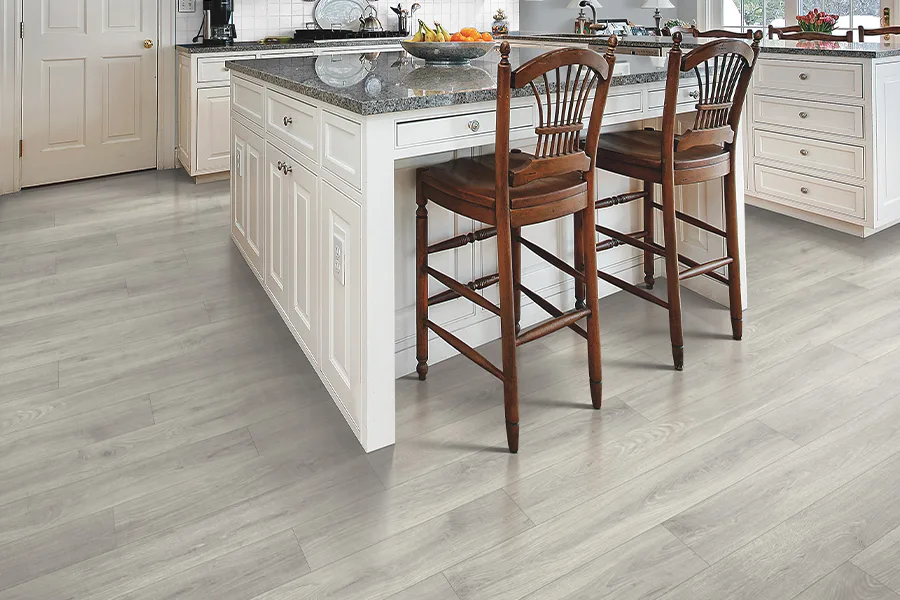
An AC rating tells you how long the clear top layer of a laminate board holds up against grit before the wood-look print underneath starts to wear through. Thickness tells you something else: how solid the floor feels and sounds, how well it copes with small dips in the subfloor and how much it raises the floor. Neither number, on its own, tells you how good the floor will look in five years.
For most homes the choice is fairly simple. AC3 is enough for bedrooms and other quiet rooms. AC4 is the better pick for entries, kitchens, hallways and stairs, and for any house with kids, dogs or renters. An 8 mm board works in most rooms, and 10 to 12 mm pays off where you want a quieter, more solid step or where the subfloor is less than perfect.
What an AC rating measures
A laminate board is mostly a core of dense wood-fiber board. On top of the core sits a printed image of wood or stone, and over that a clear sheet of resin filled with small, hard, transparent particles of aluminum oxide. That protective sheet is thin, roughly 0.05 to 0.1 mm, and the whole decorative surface, print included, is only about 0.2 mm thick. The AC rating grades how well that thin surface resists being worn away.
The rating comes from a lab test. A sample of the board is set on a turntable under two wheels wrapped in sandpaper, and the wheels grind the surface as it spins. The paper is changed regularly so it stays sharp, and the lab keeps counting turns until the print has worn through in three of the sample's four quarters. The more turns the surface survives, the higher its class. The test and the class scale come from EN 13329, the European standard for laminate floors, and that code often appears next to the AC number on a spec sheet.
So an AC rating measures wear-through: the point where the pattern is gone, the core shows and the floor has reached the end of its life.
Laminate AC rating chart
The classes run from AC1 to AC5, and some newer boards carry AC6. In the current European table, AC3 means the print lasted past 2,000 turns of the sanding wheels, AC4 past 4,000, AC5 past 6,000 and AC6 past 8,500. Charts online sometimes list slightly different cut-offs, because the standard has been revised over the years, but the order of the classes has stayed the same.
| AC class | What it is rated for | Where it fits in a home |
|---|---|---|
| AC1 | Moderate home use | Closets and rarely used rooms |
| AC2 | General home use | Bedrooms and guest rooms |
| AC3 | Heavy home use; moderate commercial use | Most rooms in a quieter household |
| AC4 | General commercial use | Entries, kitchens, hallways, stairs, busy households and rentals |
| AC5 | Heavy commercial use | Stores and public buildings; more than a home needs |
| AC6 | Above AC5, on some newer products | Commercial spaces |
AC3 vs AC4 laminate: which one do you need?
Choose AC4 for any floor that carries the household's daily traffic, and keep AC3 for rooms where people mostly walk in socks. An AC4 board has to last about twice as many turns of the sanding wheels as an AC3 board before its print shows, and that margin counts most where feet follow the same path every day:
- Entries and mudrooms, where grit comes in on shoes before anyone can sweep it up.
- Kitchens, where people stand, turn and shuffle in the same spots at the counter and sink.
- Hallways and the main path between rooms.
- Stairs, where every step lands on the same small patch at the front of the tread. Stairs also need glued-down boards and a matching stair nose, which our guide to safer staircase makeovers walks through.
- Homes with large dogs or young kids, where the floor sees more traffic and more tracked-in dirt.
- Short-term rentals, where a new group arrives every few days. Our post on waterproof laminate for rentals and Airbnbs covers what else guests put a floor through.
AC3 is fine in bedrooms, guest rooms and a home office, as long as the desk chair rolls on a mat.
One practical catch: laminate usually runs as one continuous floor through connected rooms, so an open kitchen, dining and living area gets a single product. Choose it for the busiest spot in that space. If you would like to start your search there, you can narrow our catalog to AC4-rated laminate.
AC5 is rated for stores and public buildings. It does no harm at home, but you would be paying for durability a house seldom uses.
What an AC rating doesn't tell you
Most laminate floors start to look worn long before any print wears through. That is the central point of a 2023 white paper from the North American Laminate Flooring Association (NALFA), the trade group that brings together laminate makers, importers and retailers and writes the performance standard for laminate sold in North America. The association promotes laminate on behalf of its members, so it is not a neutral voice, but here it is warning shoppers not to lean too hard on a number the industry itself advertises. The AC rating covers wear-through and nothing else. It leaves out:
- Scratches. A test sample can pick up scratches in the first few turns and still score well, because the lab counts until the print is gone. Fine scratches from pet nails, chair legs and dragged grit are a separate property, and the European standard added its own micro-scratch measure in its 2016 edition.
- Dents. How well a board survives a dropped pan or a narrow chair leg depends mostly on how hard and dense its core is.
- Stains. Stain resistance comes from the chemistry of the surface layer and has nothing to do with the abrasion class.
- Fading. Resistance to sunlight is a separate property as well, and a high AC class does not imply it.
- Water. The AC rating says nothing about how a board handles spills, pet accidents or wet boots. Water protection is its own feature, with its own claims and warranty terms.
This matters when you read a warranty, too. For warranty purposes, laminate makers define wear as the protective layer wearing away until the print is worn through. A floor that is scratched or dull but not worn through has not "worn out" under that definition, so check what your warranty says about scratches before you count on it.
Independent testing points the same way. Consumer Reports, which runs its own flooring tests, scores laminate on scratches, stains, dents, water and sunlight as well as foot-traffic wear, and it found that the best laminates resist scratching and sun fading better than most wood floors. It also notes the catch that comes with that tough top: once the layer has worn through, the boards have to be replaced, because laminate cannot be sanded and refinished the way hardwood can. Keeping a box of spare boards from the original order makes a later repair easier to match.
When you compare boards in person, look at the surface as well as the rating. A textured, low-gloss finish disguises fine scratches better than a smooth, shiny one, which counts for a lot in a house with dogs and rolling chairs.
The North American rating: NALFA certification
North America's own laminate standard, known as LF-01, does not use AC classes at all. The AC scale is European, and it became common in laminate marketing here anyway. LF-01 instead certifies a floor at one of four levels: Residential, Light Commercial, Commercial or Heavy Commercial. To earn a level, a product has to pass tests in 14 categories at an approved independent lab, such as the wood products lab at North Carolina State University. The tests cover wear, impact, staining, light resistance, moisture resistance, heavy static loads and rolling chairs, among others, and each level sets its own bar for wear, scratch, impact and stain. Certification also requires meeting federal formaldehyde limits.
If a box carries the NALFA seal, its level tells you more than an AC number, because it reflects that whole set of tests. NALFA runs the seal program, so it naturally recommends looking for it; the testing itself is done by the outside labs.
Is there a wear layer thickness for AC4 laminate?
Not in the way vinyl flooring has one. Laminate's protective layer is a fraction of a millimeter on every board, so makers rate it by how it performs in the abrasion test instead of by how thick it is. That is what the AC number describes.
Luxury vinyl is built and rated differently. A vinyl plank lists its wear layer in mils, or thousandths of an inch; a rigid vinyl plank might list a 20 mil wear layer, about half a millimeter. Because the two materials are made and tested so differently, an AC4 laminate and a 20 mil vinyl plank cannot be compared number to number. If you are deciding between the two, look at how each handles water, sound and feel in the room you have in mind; our comparison of waterproof laminate and luxury vinyl for kitchens lays out those trade-offs.
What laminate thickness changes, and what it doesn't
Laminate usually runs from about 6 to 12 mm thick, and 8 and 10 mm are among the most common sizes. Nearly all of that is the fiberboard core. The protective surface is roughly the same thin layer on a 12 mm board as on an 8 mm one, so extra millimeters do not buy extra wear resistance. Pergo, one of the laminate brands we carry, makes the point in a technical data sheet for an 8 mm board it sells in Europe: the board is rated AC5, the heavy-commercial class.
What thickness does change:
- Feel and sound in the room. A thicker board is stiffer and heavier, so it feels more solid underfoot and sounds less hollow when you walk on it.
- Sound in the room below. Noise that travels through the floor to a downstairs room depends mostly on the underlayment. Pergo's own data sheet ties its sound-reduction figure to the underlay used, not to the board. If you live in a condo or townhome with neighbors below, ask your association whether it has a sound requirement for hard floors before you choose.
- Uneven subfloors. A thicker, stiffer board bridges tiny imperfections a little better, but it does not change what the floor underneath has to be. Mohawk and Pergo laminate share one set of installation instructions, and the current version allows no more than 3/16 inch of unevenness over 10 feet, with no exception for thicker boards. High spots get ground down and low spots get filled first. If your quote includes floor leveling, that is the reason, and our page on flooring installation explains how we approach the prep work.
- Floor height. Every millimeter, plus any pad, raises the floor. That affects how doors clear, how the laminate meets tile or carpet at a doorway, whether a dishwasher can still slide out and which stair nose fits. It seldom rules a board out, but it is easier to plan for before the floor goes in.
Does an attached pad count toward the thickness?
When a board comes with underlayment already attached, check whether the stated thickness includes it. A 10 mm board with a 2 mm pad is a different floor from a 12 mm board with no pad. Over a wood subfloor, an attached pad usually means no separate underlayment is needed. Over concrete, such as a basement slab, Mohawk's and Pergo's instructions still call for a plastic vapor barrier underneath. You can filter our laminate catalog by AC rating or by built-in underlayment.
Is 7 mm laminate flooring good?
Yes, in the right room. Surface wear depends on the AC rating, so a 7 mm AC4 board has met the same wear-through minimum as a 12 mm AC4 board. What you give up is feel: a thin board sounds more hollow and is less forgiving of a subfloor that is close to the flatness limit. It suits bedrooms, guest rooms, offices and budget-minded rentals over a flat wood subfloor. In a main living area, or anywhere you want the floor to feel solid underfoot, a 10 to 12 mm board makes a noticeable difference.
Matching AC rating and thickness to your rooms
| Room | AC rating | Thickness | What else matters |
|---|---|---|---|
| Bedroom or guest room | AC3 | 7 to 8 mm | Low traffic; spend the budget elsewhere |
| Home office | AC3 or AC4 | 8 mm | A mat under a rolling chair |
| Living and family rooms | AC4 | 8 to 12 mm | Thicker boards feel more solid |
| Kitchen | AC4 | 8 to 12 mm | A water-resistant line for spills |
| Entry or mudroom | AC4 | Check door clearance | Water resistance and mats inside and out |
| Stairs | AC4 | Matched to the stair nose | Glued down, never floated |
| Basement over concrete | AC4 | Any, plus a vapor barrier | A moisture test of the slab first |
| Condo with neighbors below | By room | By room | The association's sound rules for the underlayment |
Winter grit and lake sand in Northwest Wisconsin homes
In many houses around Luck, the hardest-working stretch of floor runs from the back door to the kitchen. All winter, boots carry in salt, sand and driveway gravel along with the meltwater, and in summer, lake-home floors get beach sand on bare feet and wet dogs. Sand and grit underfoot do on a small scale what the sandpaper wheels do in the AC test, so these paths are where AC4 matters most.
Because floors look worn well before they wear through, keeping grit off the floor protects it in ways the rating can't. A coarse mat outside the door and an absorbent one inside catch grit before it spreads, and regular sweeping or dust-mopping keeps the rest from grinding in; our guide to cleaning laminate without damaging it walks through the rest of the routine. Meltwater is the other half of a Wisconsin entry, so a water-resistant line belongs there too, and our guide to laminate that survives Northwest Wisconsin winters covers that side of the choice.
Other ratings and labels on a laminate box
- A two-digit use class, common on European-made laminate. The first digit gives the setting (2 for homes, 3 for commercial spaces) and the second the intensity of use, from 1 for light to 4 for very heavy. A board marked 32 is suited to moderate commercial use, and 33 to heavy commercial use.
- The NALFA seal and its certification level, described above.
- A water-resistance or waterproof claim. It is separate from the AC rating and comes with its own warranty terms, so read them before the floor goes into a kitchen or entry.
- "TSCA Title VI compliant." This is the federal label for composite wood products that meet the Environmental Protection Agency's formaldehyde limits. Laminate's core is a wood-fiber board, and certification to the North American standard requires the same compliance.
- The attached pad, if there is one, and its thickness.
How AC rating and thickness affect the price
Laminate is one of the lower-cost ways to get a wood look: the laminate products Consumer Reports tested cost $2 to $7 per square foot. Within one brand's lineup, a higher AC rating and a thicker board usually cost more, and the look, the texture and water protection affect the price too. Installation, subfloor leveling, stairs and trim come on top of the material.
If the budget is tight, spend where the wear happens. An AC4 board of moderate thickness across the main floor usually serves a home better than a thick AC3 board, because thickness improves the feel while the AC rating is what holds up to traffic.
When you have a few laminates in mind and want to know which rating and thickness suit your rooms, doorways and subfloor, request a free in-home estimate and we will give you measured numbers for the boards you are considering.


