


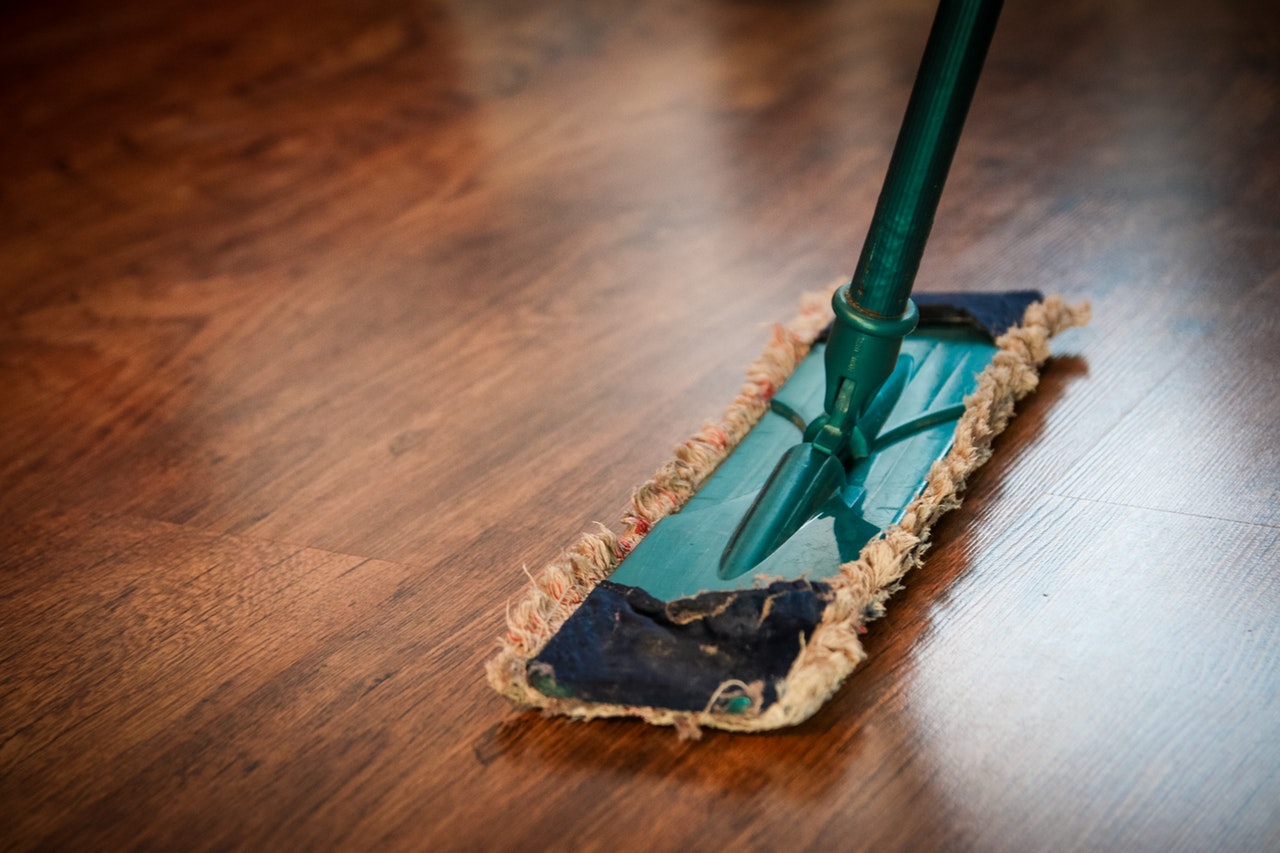
To clean laminate without damaging it, get the grit off first and keep water to a minimum. Sweep, dust-mop or vacuum often. Damp-mop only when the floor needs it, with a mop wrung almost dry or misted lightly, and use a cleaner your floor's maker approves. Wipe up spills as soon as they happen. Wax, polish, oil soap, detergents, abrasive powders and vacuums with a spinning beater bar are off limits.
Past those basics, the rules depend on which laminate you have. Makers disagree about whether a vinegar or ammonia mix is safe, and some newer waterproof lines are approved for wet mopping or even steam while other boards from the same brand are damp-mop only. Cleaning a floor the way its maker forbids can cost you the warranty, so find your floor's own care instructions before you buy a steam mop or mix a bucket.
The everyday routine that protects laminate's finish
Grit does its damage slowly. Sand and dirt carried in on shoes and paws can scratch the clear top layer each time someone walks over them, so laminate makers put regular dry cleaning at the top of their care routines. These habits protect the finish:
- Dry-clean often. Use a soft broom, a microfiber dust mop or a vacuum on its hard-floor setting with the beater bar switched off. How often depends on traffic: a back entry in January may need it daily, a guest room once a week.
- Keep the mop head clean. Swap a dirty microfiber head for a fresh one, and wash the used ones without fabric softener. Softener stays in the fibers and can leave streaks on the floor.
- Damp-mop only occasionally. When the floor needs more than a dust mop, wring the mop until it is barely damp or mist the pad, never the floor, and don't leave anything standing.
- Mat every outside door, inside and out. Outside, use a mat that combines coarse fibers, which scrape soles, with softer ones that soak up water. Indoors, use an absorbent mat with a breathable, non-staining back. Rubber-backed mats can trap moisture against the floor or stain it. Shake mats out and clean under them, because grit caught underneath dulls the finish.
- Protect it from furniture. Put felt pads at least an inch across under chair and table legs, set rolling chairs on a mat or swap hard plastic casters for rubber wheels, and lift heavy pieces instead of sliding them.
- Trim pets' nails. Short nails leave far fewer fine scratches.
Check which laminate you have before you mop
When it comes to water, laminate is not one product. Entry-level boards resist a spill that's wiped up promptly, while newer lines are sold as waterproof, and the difference lands on the very things a cleaning routine involves: how wet the mop can be, how long a spill can sit, and whether steam is allowed.
Mohawk's RevWood laminate, one of the lines we sell, shows how wide that range is inside a single brand. Mohawk publishes one care and warranty booklet for its wood-based floors, and because RevWood's warranty coverage depends on following it, that booklet is the rulebook for a RevWood floor. The current edition, from January 2026, sorts RevWood into these levels:
| RevWood level | Water protection | Mopping the warranty allows | Spills and pet accidents |
|---|---|---|---|
| Essentials | Wet resistance | Damp mop only; no wet or steam mopping | Spills wiped up within 30 minutes; pet urine not covered |
| Select | Waterproof | Damp or wet mop; no steam | Household spills and pet accidents covered |
| Plus and Premier | WetProtect | Damp, wet or steam mop | Spills and pet accidents covered, including damage to the subfloor |
Other brands draw their own lines. Pergo, another laminate brand we carry, says its WetProtect laminate can be wet-mopped and steam-mopped. So the rule for your floor sits in that floor's care guide and warranty, and a general tip online can be right for one laminate and wrong for the one in your kitchen.
If you don't know what you have, the receipt or installation paperwork usually names the brand and product line, and a leftover box carries the name on its end label. The warranty booklet tells you what the coverage is, and the store that sold the floor can often look it up from the original order.
One more detail in the same booklet affects mopping near the walls. RevWood's waterproof coverage assumes the edges of the floor were sealed during installation as the instructions describe, and damage at an unsealed edge, including damage from wet or steam mopping, is not covered. If you're not sure your floor's edges were sealed, keep the mop light along the baseboards.
Which cleaners are safe on laminate floors?
A cleaner made for laminate, or a homemade mix your floor's maker names, used sparingly. The products to avoid are the same on every laminate floor; the homemade mixes are where makers part ways.
Products to keep off any laminate floor
Laminate makers agree on this list: keep wax, polish, oil soap, detergents and other soap-based cleaners, abrasive cleaners and scouring powder, and anything sold as a shine restorer off laminate. The surface doesn't need wax or varnish to look its best, soap-based cleaners leave it looking dull, and abrasives scratch it. The RevWood warranty spells out the cost: damage from detergents, abrasive cleaners, soaps, waxes or polishes, or from overly wet cleaning, is not covered.
Vinegar and ammonia: makers disagree
This helps explain why online advice about vinegar contradicts itself. Mohawk and Pergo, which belong to the same parent company, give the same recipe: about 1 cup of household vinegar, or 1/3 cup of non-sudsing ammonia, in a gallon of warm water. Mannington, another large American laminate maker, suggests a clear, non-sudsy ammonia-based cleaner in warm water. Bruce, whose laminate we also sell, lists both ammonia-based cleaners and vinegar among the products that can damage its floors, and points owners to the hardwood and laminate cleaner it makes instead.
Each maker is writing rules for its own surface, and its warranty is built on them, so there is no single answer to whether vinegar is safe on laminate. Use the mix your floor's maker names, at the strength it gives, and don't make it stronger. If you can't find out who made your floor, a cleaner sold for laminate floors, misted lightly onto the mop pad, is a safer default than guessing at a recipe.
Spray mops and store-bought cleaners
A spray mop is a handy way to put down a light mist, as long as the liquid in it is one your floor's maker allows. The RevWood instructions rule out household cleaning products other than the ones Mohawk recommends, and the warranty also excludes damage from jet mops, floor scrubbers and buffers. Check your own warranty's list of excluded tools before you settle on one.
Can you steam mop laminate floors?
Only if your floor's warranty says so. For most laminate the answer is no, and the RevWood warranty, for one, excludes steam-mop damage unless the product carries steam coverage. The exceptions are a few waterproof lines, such as Mohawk's RevWood Plus and Premier and Pergo's WetProtect laminate. If yours is one of them, the RevWood booklet says to set the steam mop to its wood-floor setting or its lowest one, and to run it along the length of the planks only. The sealed-edge condition described above applies to steam as well.
How to clean laminate floors without streaking
Streaks usually come from something left on the floor: too much cleaner, film from a soap-based product, dirt spread around by a pad that was already dirty, or fabric softener in the mop head. A streak-free clean looks like this:
- Sweep or vacuum first, so the mop isn't pushing dust and grit around.
- Start with a clean pad, and change it as soon as it looks dirty.
- Mist the pad lightly instead of spraying the floor, and mix any cleaner at the strength its label or your floor's maker gives.
- Work one small area at a time, and dry any damp patch with a clean towel before moving on.
If an older film has built up from the wrong product, clean with your approved cleaner and fresh pads and dry as you go. If the haze won't lift, or someone used a polish or shine product on the floor, call the floor maker's customer line before trying anything stronger.
How to clean laminate without causing water damage
Water damages laminate through the joints between planks. Most laminate is built on a core of high-density fiberboard, compressed wood fiber, and water that works into the seams can make the board edges swell. Keeping water out of the joints comes down to a few habits:
- Blot spills right away with an absorbent cloth. If the spot needs more, mist a microfiber cloth with your cleaner and wipe from the outside of the spot toward the center.
- Never pour water or cleaner straight onto the floor, and don't leave puddles or wet patches behind.
- Clean pet accidents up immediately; as the table above shows, not every warranty covers pet urine.
- Let the floor dry completely before putting a mat or rug back over a damp spot.
If water gets under the floor
A leak is a different problem from a spill. Even the WetProtect coverage in the table above does not cover flooding, standing water, leaking pipes or leaking appliances such as dishwashers and icemakers. Shut off the water, get the standing water up, and start drying the room right away with fans and a dehumidifier. North Dakota State University's extension service, which advises homeowners across the northern plains on drying out after floods and leaks, warns that wet building materials grow mold within one to three days depending on temperature. University flood-cleanup guides also advise taking up floor coverings where needed so the subfloor underneath can dry.
Once board edges have swollen, the usual fix is new boards. Laminate makers send owners with damage beyond a touch-up to a professional who can replace the affected planks. That is a job for someone who does flooring installation, and it goes much more smoothly with spare boards from the original order, so keep any leftover boxes.
Winter slush, salt film and summer sand
Around Luck and the rest of Northwest Wisconsin, the hardest months for a laminate floor are the ones with snow on the boots. Two things come in with it: meltwater, and whatever was spread on the driveway and the road.
Meltwater. Snowy boots left by the door can leave a puddle for hours. On a floor rated only for spills, such as RevWood Essentials with its 30-minute limit, that is exactly the kind of standing water the warranty doesn't cover. A boot tray inside the door keeps the melt off the boards. Pair it with an absorbent mat with a breathable back, and on wet days lift the mat to let the floor under it dry.
Salt film. CleanLink, a trade publication for professional cleaning crews, describes two kinds of deicer residue: rock salt dries to a white powder that dulls a floor's finish if it sits, while calcium chloride and magnesium chloride melts leave an oily film that can make smooth floors slippery. Its advice for commercial floors calls for detergent or a mildly acidic cleaner, and detergent is on laminate makers' lists of things to avoid. On laminate, vacuum or sweep up the dry residue and grit first, then damp-mop with your maker's approved cleaner, switching to a fresh pad as the old one loads up. If your maker lists the vinegar mix, that mildly acidic solution is the kind of cleaner the professionals reach for on deicer grime.
Sand. At a lake place, summer swaps salt for sand, and it wears the floor the same way winter grit does, along whatever path leads in from the beach. Dry-clean that path more often in beach season. How much abrasion a laminate's top layer can take before its print wears through is what its AC rating measures, and our guide to laminate thickness and AC ratings explains which rating suits which rooms.
Removing stains, scuffs, gum and wax
Laminate's sealed top resists most stains, and most spills wipe off with a damp cloth. For the ones that don't, the makers' spot-cleaning charts line up closely. Try anything stronger than water on a hidden spot first, such as inside a closet.
| Problem | What to use | Keep in mind |
|---|---|---|
| Juice, wine, grease, chocolate | Lukewarm water and a non-abrasive cleaner on a soft cloth | Blot and wipe; don't scrub |
| Marker, crayon, lipstick, ink, shoe polish, nail polish, tar | Rubbing alcohol or mineral spirits on a clean cloth; some makers also list nail polish remover | Keep solvents off baseboards and quarter round, and wipe the spot with your regular cleaner afterward |
| Black scuffs from rubber soles or wheels | Acetone (nail polish remover) on a cloth | A little on the cloth is enough |
| Chewing gum, candle wax | Harden it with ice in a sealed bag, then lift it with a blunt plastic scraper | Let it harden fully before scraping |
| Glue | A remover suited to the glue, then a normal cleaning | Follow the remover's label |
| Small chips and dings | A color-matched repair putty or touch-up kit from the floor's maker | Larger damage means replacing the plank |
More laminate care questions
How do I make laminate floors shine again?
Clean the floor instead of coating it. Laminate's sheen is part of its top layer and doesn't need wax or polish, so a floor that has gone dull usually has something on it: soap film, too much cleaner, or a shine product. Removing that film, as in the streak steps above, usually brings back the original look. A traffic path where the wood-look print has worn away is wear, and no cleaner will bring it back.
Are robot vacuums and robot mops safe on laminate?
A robot vacuum suits the frequent dry cleaning laminate needs, with the same caution as any vacuum: makers warn against beater bars and power brush heads, so use a hard-floor mode if it has one, and check whether your floor's care guide says anything about rotating brushes. A robot mop is a damp mop. It belongs only on a floor whose maker allows damp mopping, with the water flow set low and your approved cleaner in the tank.
What kind of mop works best on laminate?
One you can wring almost dry or that works from a light mist, which in practice means a flat mop with a washable microfiber or terry cloth pad. A string mop and bucket make it hard to keep the water down, and excess water is what damages laminate.
When cleaning can't fix the floor
Some problems aren't dirt. A path where the print has worn through, edges that have swollen and stayed raised by the back door or the dishwasher, or a damp-mop-only floor in a mudroom where boots drip all winter are all signs the floor is due for replacing. Our article on choosing laminate that survives Northwest Wisconsin winters covers what to look for at an entry, and our laminate selection includes RevWood, Pergo and Bruce lines; ask about each line's water rating along with its look. If a new floor is the answer, set up a free estimate and bring the cleaning questions from this article with you, since how a floor may be mopped is one of the ways laminate lines differ most.


