


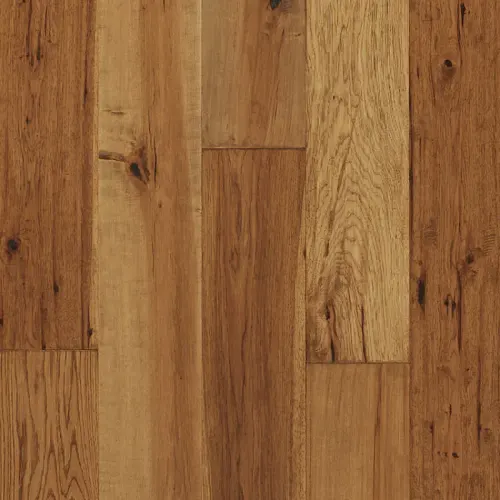
The best hardwood for a Wisconsin cabin is a hard, busy-grained species like hickory or oak, built as an engineered plank, and finished in a low-sheen wire-brushed texture. That combination delivers the warmth and character cabin owners want while standing up to the thing that actually wrecks wood floors up here: the swing between bone-dry winters and humid summers, far more than the cold itself. Get the wood, the construction, and the humidity right, and a cabin floor lasts for decades. Get them wrong and it gaps, cups, and squeaks by the second season.
You know the feeling this is really about. You arrive after a long Friday drive, kick off snow-crusted boots by the door, and feel real wood underfoot as the woodstove takes the chill off. That feeling is why so many owners near Luck and the surrounding lakes insist on hardwood. The trick is choosing a floor that delivers it through subzero nights, spring melt, and sandy summer traffic. This guide covers the whole decision, from species and construction to finishes, cost, installation, and care, and it leans on the wood-science and flooring standards that actually govern how a cabin floor behaves.
The Short Answer: What Makes a Great Cabin Floor
A great cabin floor balances three things: warmth, character, and dimensional stability through big humidity swings. Here's the quick version before the detail.
Choose engineered construction. Its cross-layered core moves far less than solid wood through a cabin's wet-to-dry seasons.
Pick a hard, busy-grained species. Hickory and oak resist dents and hide the dings, sand, and dog scratches cabin life brings.
Go matte and textured. A low-sheen, wire-brushed surface grips damp feet and hides scratches a glossy floor would show.
Control humidity. Keeping indoor air near 35% to 55% relative humidity is what stops gapping and cupping.
Real wood pays back. Hardwood is renewable, refinishable, and adds resale value a cabin keeps for decades.
What Cabin Life Demands from a Wood Floor
A Wisconsin cabin puts a wood floor through more stress than a typical suburban living room, and almost all of it comes down to moisture. Wood is hygroscopic, meaning it constantly trades water vapor with the air around it. The USDA Forest Products Laboratory, whose Wood Handbook is the reference text on how wood behaves, describes this as reaching an equilibrium moisture content: a board keeps absorbing or releasing moisture until it matches the humidity of the room. When the air is damp, boards swell. When the furnace runs all winter and the air dries out, they shrink. A cabin sees both extremes, often in the same year.
Two familiar problems come out of that cycle. Gapping is the thin dark line that opens between boards in the driest weeks of winter, when the wood has shrunk. Cupping is when a board's edges lift higher than its center, usually after the underside picks up moisture from a damp slab or crawlspace. Neither means you bought the wrong floor. It usually means the indoor humidity drifted too far, which is the single most important thing to manage in a cabin, and the subject of our deeper guide to how Wisconsin winters affect hardwood.
The part-time cabin is the hardest case of all. When a place sits empty, the air goes uncontrolled for days or weeks, and the floor rides every humidity swing with no furnace or humidifier to steady it. Lake homes add their own load, since bare feet track in water and sand all summer and boots bring snowmelt all winter. Our guide to hardwood floors for lake homes near Luck digs into that mix of moisture and grit.
Why Wood Feels Warm in a Cold Cabin
Wood feels warmer underfoot than tile or stone because it carries heat away from your skin far more slowly. Thermal conductivity is the measure of how fast a material moves heat, and hardwood sits around 0.12 watts per meter-kelvin, while stone runs closer to 2, more than ten times higher. Step onto tile at room temperature and it pulls warmth from your foot fast, so it feels cold; step onto wood at the same temperature and it barely draws any, so it feels warm. That difference is physical, not just perception, and it's a real reason wood suits a cold-climate cabin.
The same property makes wood a comfortable partner for the woodstove or the morning chill. Common flooring woods carry a modest insulating value, roughly an R-0.6 to R-1.0 depending on species and thickness, so a wood floor over a warm subfloor holds that warmth a little longer than a dense, conductive surface would. It won't replace insulation under the cabin, but on a February morning, the floor you step onto first is one you'll be glad is wood.
Why Wood Moves, and Why Construction Matters Most
Wood moves more across its width than along its length, and it moves more one way through the growth rings than the other. The Forest Products Laboratory puts the average shrinkage from green to bone-dry at roughly 8% tangentially, along the growth rings, versus about 4% radially, across them. That two-to-one difference is why a wide plainsawn board swells and shrinks noticeably across its face, why quartersawn boards stay flatter, and why the widest solid planks gap the most in a dry winter. In a cabin, where humidity is hard to hold steady, that movement is the enemy of a floor that stays tight.
Engineered hardwood is the answer to it, and it's why most cabin floors we install are engineered rather than solid. An engineered plank is a real hardwood top layer bonded over a plywood-style core, with the grain of each layer running crosswise to the next. Those opposed layers pull against each other and hold the plank flat when humidity changes, so an engineered floor can go over a concrete slab, in a walkout basement, or on any level of the home. Solid hardwood can't. Because a solid board is one piece that moves freely, the National Wood Flooring Association, which writes the U.S. installation standards for wood floors, advises against solid wood below grade, and most manufacturers won't warranty it there. We walk through that trade-off in our look at engineered versus solid hardwood in Northwest Wisconsin basements.
Heat sources change the math too. Many cabins run radiant floor heat or throw off hot spots from a woodstove or fireplace, and concentrated heat dries wood out fast. The NWFA recommends engineered wood over radiant heat, kept below about 80 degrees at the surface, and it calls for running a new radiant system for two weeks before the floor goes down so the slab is fully dry. Solid wood over radiant is a gamble in our climate. Engineered wood is the version built to take it.
The Best Wood Species for a Cabin
For a cabin, the best species are the hard, strongly grained ones, and hickory and the oaks lead the list. Flooring durability is measured on the Janka hardness scale, which records the force needed to press a small steel ball halfway into a board. Red oak sits at 1,290 on that scale and is the benchmark the whole industry compares against. The higher the number, the better a floor resists the dents that firewood, furniture, and dog nails leave behind. Here's how the common cabin species stack up.
Species | Janka hardness | Why it works (or doesn't) in a cabin |
|---|---|---|
Hickory | 1,820 | The hardest common domestic wood, with the busiest grain; hides dents and scratches beautifully |
Hard maple | 1,450 | Very hard but smooth and uniform, so dents and seasonal gaps show more |
White oak | 1,360 | Hard, with a tight closed grain that sheds water better than most; classic and forgiving |
Red oak | 1,290 | The industry benchmark; strong open grain hides wear, widely stocked and affordable |
Black walnut | 1,010 | Rich and gorgeous, but softer, so it dents more easily; best in lower-traffic rooms |
Hardness isn't the whole story, though, and this is where cabins differ from a formal living room. A very hard but very uniform floor, like clear maple, actually shows dents and gaps more, because there's no grain pattern to camouflage them. The busy, varied grain of hickory and oak does double duty: it's tough, and it hides the marks that do get through. That's why the two most popular cabin species aren't the absolute hardest woods on earth, but the ones that pair real hardness with a forgiving look. Exotic species like Brazilian cherry run harder still, but they read as formal and cost more, which is why the homegrown hardwoods usually win in a Northwoods setting. When you're ready to compare, the hardwood Jensen carries runs from red oak and hickory to engineered lines from brands like Mercier, Mohawk, and Bruce.
Among the top three cabin woods, the choice comes down to grain and moisture. White oak is the most water-tolerant of the group, because its tight, closed grain and natural tannins shed spills and resist rot better than red oak's more open pores, and its warm brown tone suits a rustic room. Red oak is a touch softer at 1,290 and pinker in tone, but it's the most widely stocked and usually the most affordable, and its strong grain still hides wear well. Hickory is the toughest and most dramatic, swinging from pale sapwood to dark heartwood in a way that makes scratches and tracked-in sand all but disappear; the trade-off is that its hardness and busy look make it a little harder to work and refinish. For a lake cabin that takes on water and sand, white oak or hickory usually edges out red oak.
Character Hides Wear: Grade, Grain, and Finish
In a cabin, character is a performance feature as much as a style. Wood is graded by appearance rather than by strength, so every species comes in clearer grades that look uniform and character grades that show more knots, mineral streaks, and color variation. The clearer grades cost more and read as formal. The character grades, sometimes sold as rustic or cabin grade, cost less and hide a decade of hard use, because a dropped pan or a sandy paw print disappears into a floor that already has plenty going on. For a lakeside retreat, that natural variation is the whole point.
Finish and texture finish the job. A matte or satin finish reflects less light than gloss, so it hides fine scratches and the haze of dried lake water instead of spotlighting them. A wire-brushed or lightly hand-scraped surface adds a subtle texture that grips damp or sandy feet near the door and camouflages wear over time. Put those together, a busy-grained species in a character grade with a low-sheen brushed finish, and you get a floor that looks better dirty than a glossy floor looks clean. Our guide to designing a cozy Northwoods cabin shows how to pair that floor with furniture and rugs.
Plank Width and the Northwoods Look
Wide planks give a cabin that open, timber-frame character, but width is exactly where seasonal movement shows up, so the wider you go, the more the construction matters. A board twice as wide has twice as much material to shrink and swell across its face, which is why a wide solid plank opens the biggest winter gaps. The fix isn't to give up the look. It's to get wide widths in an engineered plank, where the cross-layered core holds broad boards flat through the seasons.
The width also raises the bar on moisture control before installation. The NWFA sets tighter limits for wide boards: strip flooring under 3 inches can go down with up to a 4% moisture-content difference between the wood and the subfloor, but plank flooring 3 inches and wider allows no more than a 2% difference. That's a measurable reason wide-plank cabins need careful acclimation and moisture testing rather than just a good eye. A wide engineered plank, properly acclimated, gives you the Northwoods look with the stability a cabin needs.
Solid vs Engineered Hardwood for Cabins, Side by Side
Engineered hardwood wins for most Wisconsin cabins because it holds still through humidity swings, handles slabs and basements, and takes radiant heat. Solid hardwood still has a place in a heated, above-grade cabin lived in year-round, mostly because it can be refinished more times. Here's the head-to-head.
What matters in a cabin | Solid hardwood | Engineered hardwood |
|---|---|---|
Movement with humidity | Moves the most, especially in wide planks | Cross-layered core moves far less |
Over concrete or basements | Not recommended below grade | Works on any level, over a vapor barrier |
Radiant heat or woodstove hot spots | Risky in a dry climate | Recommended; keep the surface under 80 degrees |
Refinishing | Many times over its life | Once or twice, depending on the top-layer thickness |
Wide planks | Higher risk of gapping | Holds wide widths flatter |
Part-time or unheated cabins | Higher risk of movement | More forgiving of swings between visits |
Upfront cost | Higher for wide planks | Often lower for a comparable look |
Finishes and Healthy Cabin Air
The finish decides how well a cabin floor resists scratches and how clean its air stays. Most quality wood flooring now arrives prefinished from the factory, coated in a urethane loaded with aluminum oxide, a mineral that rates about 9 on the 10-point Mohs hardness scale and makes one of the toughest surfaces available for wood. It's cured hard under UV light at the mill, so it resists scratches better than a finish brushed on site and is ready to walk on the day it's installed. For a cabin that has to shrug off grit and paws, that factory finish is worth choosing on purpose.
Air quality matters more in a cabin than people expect, because a tightly closed-up retreat traps whatever the floor gives off. Wood finishes and the glues in engineered cores can release volatile organic compounds, or VOCs, into the air, and a few certifications tell you how little. FloorScore checks the finished floor against California's indoor-air standard. GREENGUARD Gold is stricter, the seal used for products going into schools and hospitals. CARB Phase 2, now part of a federal rule, caps the formaldehyde in engineered cores. Our overview of low-VOC, eco-smart wood floors explains what to look for on the box.
Installing Hardwood in a Cabin the Right Way
A cabin floor lives or dies on the install, because the same humidity swings that stress the wood also punish shortcuts. The first step is acclimation: the flooring has to sit in the cabin until it reaches the moisture level it will live at, and a good crew tests both the wood and the subfloor with a meter before a single board goes down. The NWFA wants the two readings close, within 4% for narrow strip flooring and within 2% for plank 3 inches and wider, because a big moisture gap at install time turns into gaps or cupping later. Rushed acclimation and skipped moisture tests cause more cabin-floor failures than any product defect.
Two more install details matter in our climate. The NWFA calls for an expansion gap of about 3/4 inch around the perimeter of the room and against every vertical obstruction, hidden under the baseboard, so the floor has room to swell in summer without buckling. And where a floor meets concrete, a vapor barrier goes down first to block the moisture that migrates up through a slab. These are the parts a weekend installer skips and a cabin punishes, and they're what our flooring installation is built around.
Getting the install right also protects the warranty. Most manufacturer warranties depend on the floor being acclimated, installed to spec, and kept in a controlled humidity range, and they exclude damage from moisture or neglect. It's worth knowing what's actually covered before you buy, which is why we wrote a plain-English guide to hardwood flooring warranties.
What a Cabin Hardwood Floor Costs
The cost of a cabin hardwood floor tracks a few clear drivers: the species, whether it's solid or engineered, the plank width, the grade, and how much prep the subfloor needs. Common domestic species in a character grade, like red oak or hickory, sit at the friendlier end, while wide planks, premium engineered lines, and clearer grades cost more. Engineered wood is often less expensive than a solid version of the same look, and it can save on subfloor work over concrete, which is one more reason it fits cabins.
Installation and prep are real line items, not afterthoughts. A cabin on a slab may need moisture mitigation, and an old cabin may need subfloor leveling or repair before anything goes down. Those steps protect the floor and the warranty, so they're worth budgeting for rather than skipping. Spreading the project out is easy to arrange, and flooring financing lets you do the job right in one season instead of in pieces over several.
Winter Durability: Keeping a Cabin Floor Stable
The key to winter durability is holding indoor humidity steady, because the cold itself doesn't hurt wood, the dryness that comes with heating it does. The National Wood Flooring Association points to a range of 35% to 55% relative humidity, at 60 to 80 degrees, as the band where wood floors stay stable. A whole-home or portable humidifier that holds that range through the heating season is the difference between a floor that stays tight and one that gaps every January. A cheap hygrometer on the wall tells you where you actually are, which matters more than guessing.
The empty cabin is its own problem, and it has a simple answer. Leaving the heat off all winter lets temperature and humidity run wild, so the better move is to set the thermostat back rather than off and to keep humidity control running even when nobody's there. A smart thermostat and humidistat let you check both from your phone before you drive up.
The rest of cabin-floor care is about keeping grit off the finish. Grit, sand, and road salt act like sandpaper underfoot, so a boot tray by the door, felt pads under furniture, and regular sweeping do most of the work. Clean with a barely damp mop and a pH-neutral wood cleaner, never a wet mop or a steam cleaner, both of which drive moisture into the seams. Cabins that host guests or run as short-term rentals see harder use, and a periodic deep cleaning keeps grit from grinding down the finish. Jensen's professional cleaning team handles wood and other hard surfaces without over-wetting them, and can help with water cleanup if a pipe lets go during a thaw.
Is Hardwood a Good Investment for a Cabin?
Hardwood is one of the few cabin upgrades that pays for itself, and it's a genuinely sustainable choice on top of that. The National Association of Realtors' Remodeling Impact Report estimates that new wood flooring recovers about 118% of its cost at resale and that refinishing existing hardwood recovers about 147%, both rare in a field where most projects return well under 100%. On a cabin that may pass down within a family or eventually go on the market, a real wood floor reads as quality in a way laminate look-alikes don't.
The sustainability case is stronger than most people assume. According to the U.S. Forest Service's national forest inventory, the volume of U.S. hardwood growing in American forests has roughly doubled since the 1950s, and today about 2.3 hardwood trees grow for every one that's harvested. A wood floor is a renewable product that locks away carbon for the life of the cabin, and because a quality floor can be refinished rather than torn out, it stays out of the landfill for decades. Warmth, durability, and a floor you can feel good about come in the same board.
When Hardwood Isn't the Right Call
Some corners of a cabin are too wet for hardwood, and knowing where to stop is part of choosing well. Walkout basements that sit near the water table, mudrooms that catch snowmelt, and the strip of floor just inside a patio door all see moisture that will eventually find even an engineered floor. In those spots, a waterproof material is the smarter call, and the common move is to run hardwood through the main living space and switch to something resilient where the water is.
Laminate is the first alternative worth naming. It gives you a durable, budget-friendly wood look for busy lower levels, and the laminate Jensen stocks includes water-resistant lines built for exactly those spots. It handles scratches and grit well, which suits a rental or a house full of kids and dogs.
Luxury vinyl goes a step further, because it's fully waterproof and handles standing water without complaint. That makes the waterproof luxury vinyl a strong pick for a lower-level entry, a lakeside mudroom, or a bunk room that doubles as a wet-gear drop zone. Many of the best rustic vinyl planks are hard to tell from wood at a glance, so the look carries through even where real wood shouldn't go.
Common Questions About Cabin Hardwood Flooring
What is the best hardwood floor for a Wisconsin cabin?
The best cabin floor is an engineered plank in a hard, busy-grained species, finished matte and wire-brushed. Engineered construction holds still through the state's humidity swings, hickory or oak resists dents, and a low-sheen textured finish hides the wear cabin life brings. A character or rustic grade adds forgiving variation and usually costs less than a clear grade.
Should I choose solid or engineered hardwood for a cabin?
Engineered hardwood is the better fit for most Wisconsin cabins. Its cross-layered core moves far less with humidity, and it can go over concrete slabs, in basements, and over radiant heat, where solid wood shouldn't. Solid hardwood makes sense mainly in a heated, above-grade cabin lived in year-round, where its extra refinishing life outweighs engineered's stability.
What is cabin grade hardwood flooring?
Cabin grade describes how the wood looks rather than how strong it is. Wood is sorted by appearance, and cabin or rustic grades allow more knots, mineral streaks, and color variation than clear grades do. It costs less and, in a cabin, hides dents and scratches better, which is why it suits a lakeside retreat. The wood is just as structurally sound as a clearer grade of the same species.
Will hardwood gap or cup in a Wisconsin cabin?
Hardwood can gap or cup in a Wisconsin cabin, but only when indoor humidity swings too far, and it's preventable. Gapping happens when winter heating dries the wood and it shrinks; cupping happens when the underside picks up moisture. Holding indoor air near 35% to 55% relative humidity with a humidifier, and choosing engineered construction, keeps both in check. Wide solid planks gap the most, so engineered is the safer choice for a wide-plank look.
Can I put hardwood over a concrete slab or in a walkout basement?
Engineered hardwood, yes; solid hardwood, no. Engineered planks are approved for on, above, and below grade when installed over a vapor barrier that blocks the moisture rising through concrete. Solid wood moves too much for below-grade conditions and isn't recommended there. In a chronically damp lower level, a waterproof luxury vinyl may be the more durable pick.
Is hardwood okay with radiant heat or a woodstove?
Yes, with engineered wood and some care. The NWFA recommends engineered flooring over radiant heat, kept below about 80 degrees at the surface, with the system run for two weeks before installation. Near a woodstove or fireplace, that same stability helps with the dry hot spot they create. Solid wood over radiant heat is risky in a dry-winter climate.
What's the best cabin hardwood for a home with dogs?
A hard, busy-grained species in a matte, wire-brushed finish. Hickory tops the Janka hardness scale among common woods at 1,820, and its varied grain hides the scratches nails leave; oak is a close, more affordable second. Skip high-gloss finishes and clear, uniform grades, both of which show every mark. A character grade with texture is the most forgiving floor for a dog-friendly cabin.
How do I protect a cabin floor that sits empty part of the year?
Keep the heat set back rather than off, and run humidity control even while you're away. The goal is to keep indoor air in the 35% to 55% range year-round so the floor never rides a wild swing. A smart thermostat and humidistat let you monitor both remotely, and engineered construction gives you a wider margin for the times conditions drift.
Planning Your Cabin Floor in the Northwoods
The best cabin floor is the one matched to how your place is built and used: whether it sits on a slab or a basement, runs radiant heat, gets lived in year-round or shuttered between visits, and how much lake sand and dog traffic it sees. Those answers point to a species, a construction, and a finish, and getting them right the first time is what makes a floor last.
Jensen Furniture has been fitting Northwest Wisconsin homes and cabins since 1956, seventy years of stairs, seasons, and subfloors in this corner of the state. When you're ready, request a free in-home estimate, and we'll look at your cabin's subfloor, moisture, and heat, then lay out the species and constructions that fit it. You can walk the samples at our showroom on Main Street in Luck, or read the reviews our neighbors have left before you visit. A well-chosen wood floor turns a cabin into a retreat that welcomes you in every season, and after seventy years on these lakes, it's a floor we'd be glad to help you choose.


